
Podcast Summary
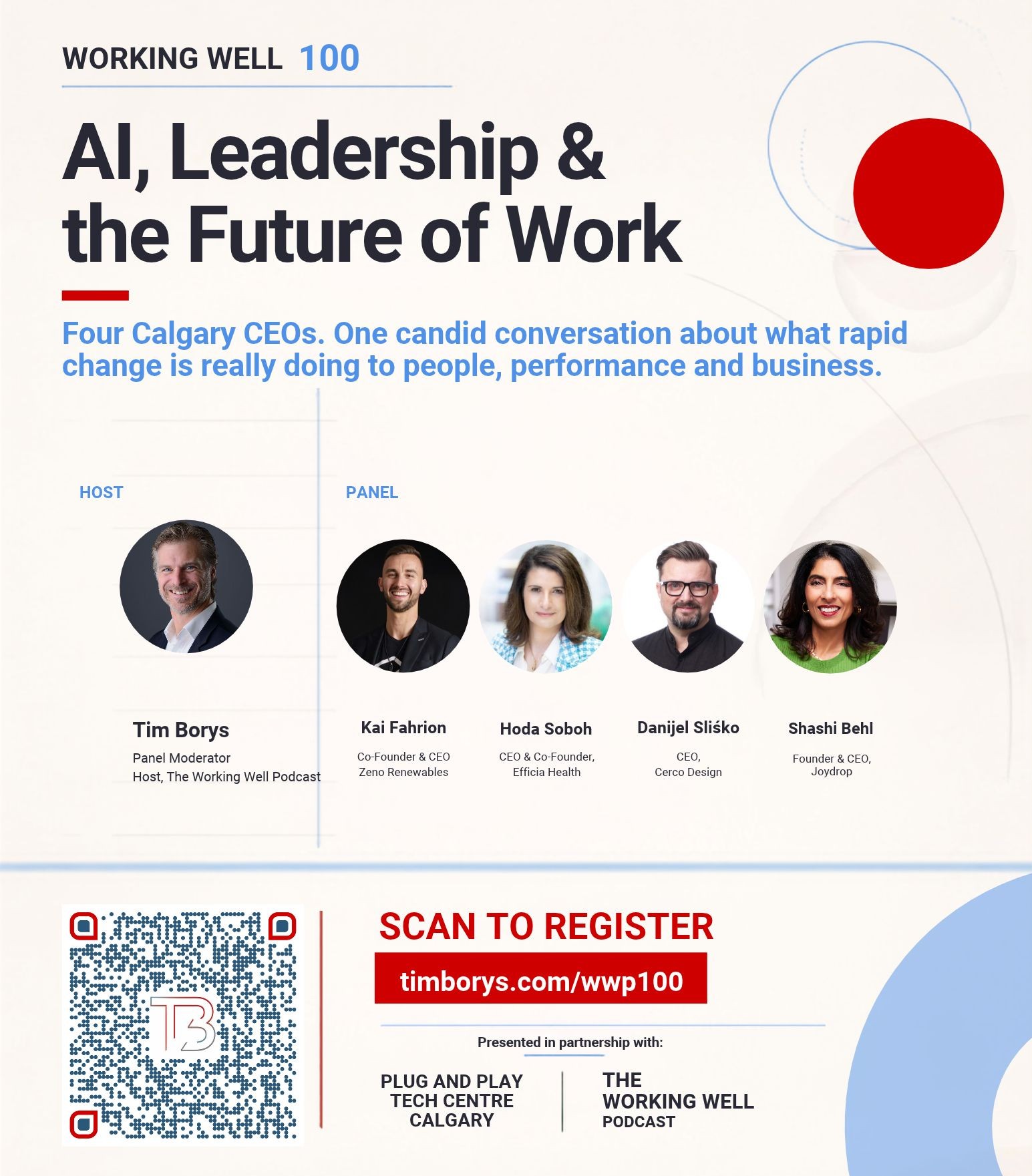
Episode 100 of the Working Well Podcast marks a milestone the show wasn’t originally built to reach what started four years ago as a 20-episode side project with a marketing intern has become a recurring exploration of the intersection of human performance, leadership, and business strategy. For this milestone, host Tim Borys did something the show had never done before: recorded live, in front of an audience, at Plug and Play Alberta, with a full four-person panel instead of a single guest.
The panel brings genuine range: Hoda Soboh, CEO and co-founder of Africa Health, building human-centered tech for midlife and menopause care; Kai Fahrion, co-founder and CEO of Xeno Renewables, scaling a brick-and-mortar solar installation business across Canada; Shashi Behl, founder and CEO of Joydrop and a veteran retailer who previously grew Twisted Goods to nine locations before selling it; and Danijel Slisko, CEO of Circo Design, on his sixth business after nearly 30 years as an entrepreneur.
The topic impossible to avoid in 2025 is AI’s impact on business and leadership. But the conversation goes well beyond tool adoption. The panel debates who actually captures the value of AI-driven productivity gains (employees or shareholders), whether small “boutique” businesses now have a structural advantage over large enterprises, what happens to human connection in an increasingly automated customer experience, and in a candid, unscripted audience Q&A whether AI is accelerating a K-shaped economy that concentrates wealth further at the top. The episode closes with an unfiltered generational torch-pass: from a founder’s personal AI-education plan for his kids, to blunt commentary on capital versus labor, to a lightning round on what each panelist hopes gets right about this AI transition five years from now.
This is a rich, occasionally uncomfortable, always candid episode for entrepreneurs, business owners, and leaders trying to separate the real opportunity in AI from the parts of the transition that deserve real scrutiny.
✅ Key Takeaways
- AI adoption looks completely different depending on the business. From healthcare data synthesis (Hoda) to automated solar-design paperwork (Kai) to AI-driven content repurposing that cut podcast production costs from thousands of dollars to $300 (Shashi), the panel shows there’s no single “right” way to implement AI only the right way for your specific workflow.
- Productivity gains don’t automatically flow to employees. Tim raised a hard question live: if AI makes someone 10x more productive, do they work less, or does the bar for “acceptable output” just rise until they burn out and get replaced? The IKEA case 8,500 customer service roles redeployed into interior design instead of eliminated, adding $1B in revenue was offered as a counter-model.
- Human connection remains the one thing every panelist agreed AI can’t replace. Whether it’s Shashi’s jewelry-as-emotional-storytelling in retail, Hoda’s insistence that clinical judgment in healthcare requires human nuance AI hasn’t matched, or Kai’s point that solar customers still want a human “validation” moment before signing connection, not information, is where the remaining human premium lives.
- Small businesses may have a genuine structural edge in the AI era. Panelists argued AI “democratizes” innovation, letting boutique operations move faster and rebuild in a week what once took a five-person team five years while large enterprises carry legacy systems and organizational inertia that slow adoption.
- The panel didn’t shy away from the uncomfortable economic questions. An audience member’s pointed question about the erosion of the middle class and a K-shaped economy the rich getting richer while more people fall into poverty led to a genuinely unresolved, thoughtful debate about monopolies, taxation, and whether AI itself or the systems around it are really to blame.
- Training and critical thinking are becoming the new competitive differentiators. Several panelists emphasized building “AI literacy” the same way parents once taught financial literacy and one panelist raised a pointed concern about whether today’s AI-assisted workforce is actually developing critical thinking skills, or just outsourcing them.
Episode Links & Resources
Connect with Kai, Danijel, Shashi & Hoda:
LinkedIn (Kai): https://www.linkedin.com/in/kaifahrion
LinkedIn (Danijel): https://www.linkedin.com/in/danijelslisko
LinkedIn (Shashi): https://www.linkedin.com/in/shashi-behl
LinkedIn (Hoda): https://www.linkedin.com/in/hodasoboh
Podcast Highlights
Please note: This highlight is generated by a computer and may contain errors.
A Milestone Four Years in the Making
Tim opened by marking the occasion: 99 episodes recorded over Zoom, and now episode 100 recorded live, in front of an audience, at Plug and Play Alberta.
“So far we’ve done 99 episodes and this is number 100… just over four years ago I started this podcast… I originally did it, I had an intern at my business, a marketing intern, and she took this on as a side project and we committed to doing, I think it was 20 episodes, and we’re at 100 right now.”
He framed the show’s throughline simply: a fascination with where human performance, leadership, and business strategy collide and, unavoidably in 2025, where AI now sits at the center of that collision.
Meet the Panel
Tim introduced four entrepreneurs spanning healthcare tech, renewable energy installation, retail, and brand/marketing consulting Hoda Soboh (Africa Health), Kai Fahrion (Xeno Renewables), Shashi Behl (Joydrop, formerly Twisted Goods), and Danijel Slisko (Circo Design) before diving into the discussion.
How Each Business Is Actually Using AI Right Now
Tim’s opening question cut straight to practice rather than theory: what is each panelist doing with AI in their business today?
Hoda described using it both personally for strategy and market trends, and structurally her healthcare business is built around AI to improve care delivery. Kai focused on client-journey efficiency: “looking at how can I make the process smoother, faster, more efficient for the company and for the client.” Shashi highlighted marketing and content creation, plus a cautious, values-led approach to chatbots given her retail business is built on customer connection. Daniel described a more aggressive, “AI rabbit hole” approach connecting his entire software stack and experimenting with agents and automation.
Doing the Same Work Faster vs. Actually Reshaping the Business
Tim pushed past adoption into a sharper question: for most people just getting started, AI just makes them do the same work faster. Where has it actually reshaped how a business operates?
Daniel offered a vivid military metaphor:
“If I look at our staff partners… they used to have machine guns, now they have this like super weapon… sometimes it’s so powerful, it’s in the wrong hands.”
Shashi shared the clearest before/after: a podcast production process that used to cost $4,000–$5,000 and required manually cutting social clips now costs about $300 with an AI tool that automatically identifies and republishes the best-performing clips across platforms a genuine one-week transformation of her entire content workflow. She also described a completely new sales channel: AI-assisted fashion design programs for private and corporate clients.
Kai described AI collapsing what used to be manual data entry photographing an electricity bill and having the software auto-populate a solar design down from a lengthy manual process to about five minutes, while maintaining human checkpoints throughout because of lingering skepticism about full automation.
Naming Your AI (and What That Says About Adoption Speed)
Hoda shared she’d been an early enough adopter to name her ChatGPT “Paxi” years ago to the point where colleagues at work now casually ask, “What did Paxi say?”
The Critical Thinking Question
Partway through, the conversation turned to a sharper concern: does using AI reveal whether someone is a critical thinker?
“AI actually, the way somebody uses it can tell you if they’re a critical thinker or not.” Hoda
Shashi agreed, and admitted it’s reshaped how her company hires:
“I can’t imagine actually laying someone off because I’ve been more efficient… efficiencies mean more money. More money means an opportunity to… create more value for a team that’s helped us get here in the first place.”
She also named a leadership discipline she’s had to build over years: resisting the “bright shiny object” impulse and pausing to ask whether a new tool is actually needed before adopting it.
Certifications, Culture, and Making Time to Learn
Daniel described a “100 Strong” internal culture built around continuous certification AI, leadership, or otherwise paid for entirely by the company, with the belief that one person stepping up to learn pulls colleagues along behind them. Shashi added a key caveat: leaders have to actually build in time for teams to learn these tools, not just expect adoption to happen organically.
What Can Never Be Automated: The Human Connection Question
Tim asked each panelist directly: as AI takes over more of the business, what’s essential to keep human?
Shashi, in retail, pointed to jewelry as “tangible pieces that become stories that preserve the emotion, preserve the connection” and argued that AI will never replace people’s desire for physical “third spaces” (a store, a coffee shop, a library) where genuine connection happens. She added, only half-joking, that no matter how well her AI (“my ChatGPT boyfriend… we’re dating”) knows her, it doesn’t give her the “warm fuzzies” of a real human interaction.
Kai pointed to a genuinely unresolved industry tension the risk of runaway AI development prompting even competing tech leaders to convene and discuss safety before landing on his own optimistic frame: humans historically simplify one part of life and redirect their energy elsewhere, and he sees AI as “100x-ing” a person’s capability rather than simply eliminating their role.
Hoda, in healthcare, was the most cautious voice on the panel:
“How many of you would be okay trusting an AI tool to diagnose you and feeling confident that… you’re gonna walk away?”
She described her own business using AI to synthesize data against clinical guidelines to give practitioners more capacity but drew a firm line at outsourcing final clinical judgment, noting that healthcare, and society more broadly, “is not there yet.”
Who Actually Benefits From 10x Productivity?
Tim posed one of the episode’s sharpest questions: if AI makes someone 10x or 100x more productive, do they work the same hours for more output, or work half the time for the same output? Who captures that value?
Daniel offered a generational read: experienced professionals who spent a decade earning a credential AI can now approximate are often quietly resentful, while younger workers entering the field see AI as pure opportunity setting up what he called a coming “revolution” as younger, AI-fluent talent undercuts established, higher-cost expertise.
Hoda pushed back on the productivity framing entirely, connecting it to a bigger historical pattern:
“The Industrial Revolution didn’t turn us into lazy, irrelevant beings… it pushed us to be creative and develop something we wouldn’t have even ever thought about.”
Tim raised the harder edge of this directly, describing a client literally building the AI model designed to replace his own department, and referenced the now well-known IKEA example roughly 8,500 customer service roles automated away by a chatbot, but redeployed into interior design consulting rather than eliminated, adding a reported $1 billion in recurring revenue.
Shashi connected this back to her own leadership philosophy: when efficiency creates surplus capacity, the answer isn’t a layoff it’s moving people into new, revenue-generating work the efficiency itself made possible.
Culture as the Next Competitive Advantage
Kai offered a striking generational contrast: where ping-pong tables and beer fridges were once the differentiator that signaled a modern workplace, the next cultural differentiator may be whether a company lets high-performing employees use AI-driven efficiency to reclaim personal time (a Pilates class on a lunch break, say) rather than simply demanding more output from the time saved.
Tim pressed on this pointedly would founders actually behave that way, or just double down on output? Kai’s answer was candid: as a young founder himself, he likely would have doubled down, but argued that strategic, AI-assisted breaks actually produce more total output across a long day than grinding without recovery.
Is the Future “Boutique”?
The conversation turned to whether AI favors small businesses or entrenches large ones further. Hoda argued AI has “democratized innovation,” letting anyone with an idea build and iterate quickly, while large companies are often slowed by legacy systems. Kai agreed nimbleness helps small players, while acknowledging deep-pocketed enterprises can still out-resource smaller competitors even as the playing field narrows.
Daniel made the most provocative prediction of the episode:
“I think the future is boutiques. The thousand people companies are in trouble… now that we have this tool to like 10x everywhere, 100x everybody within the boutique.”
He illustrated it with a personal example: an ERP system that took him and a colleague five years to build in 2010 could reportedly now be rebuilt in about a week using AI tools.
Audience Q&A: Concerns, Guardrails, and Critical Thinking
Opening the floor to the live audience, one attendee asked directly about the negative side of AI. Daniel stayed firmly optimistic, comparing AI doom narratives to movie drama rather than lived reality. Shashi agreed she leans optimistic but named a genuine concern: whether the current generation is developing real critical thinking skills, or whether education curricula need to fundamentally shift potentially starting as early as age four or five to keep pace with how quickly AI is embedding itself into work and life.
On Failure, Grit, and Building a Business From Scratch
In a warmer, more personal turn, panelists reflected on what actually built their resilience as entrepreneurs. Kai, who started his company at 22, credited his parents, sports, and Calgary’s unusually supportive business community. Hoda, speaking as an immigrant, named grit, tenacity, and curiosity as the traits that mattered most treating every job as a learning opportunity regardless of the role.
“It’s only a failure if you do it twice the first time’s a learning opportunity.” Kai
Hoda also shared a strikingly personal use case for her own AI: using it as a sounding board to unpack why a passive-aggressive email had upset her a small but telling example of AI functioning less as a productivity tool and more as a genuine thinking partner.
The Hard Question: Are We Heading Toward a K-Shaped Economy?
The most pointed moment of the Q&A came from an audience member who challenged the panel’s “boutique economy” optimism directly: with the erosion of the middle class already underway and wealth concentrating further at the top, what actually stops large companies with far more capital from simply moving faster and absorbing any advantage small businesses gain from AI?
Daniel leaned on trust as the moat boutique businesses have that capital can’t buy arguing people do business with those they know, like, and trust, and that trust gradient (low for a commodity purchase, high for a lawyer or financial advisor) is exactly where small, relationship-driven businesses can compete regardless of a large competitor’s resources.
Shashi was more measured, acknowledging real monopolistic concentration already underway and growing public appetite to push back on it through policy, while framing the current moment as a “messy middle” where education and regulation are structurally behind the pace of change.
Kai drew a historical parallel to the early, unregulated internet and the eventual breakup of early oil and gas monopolies, cautioning that overcorrecting with heavy taxation risks de-incentivizing the entrepreneurship that creates jobs in the first place while acknowledging real loopholes exist in how the wealthiest capture and shelter gains.
In the episode’s most unfiltered moment, Hoda reflecting on a recent trip to San Francisco and the visible gap between tech-company excess and street-level homelessness argued the real culprit isn’t AI or automation at all:
“It is the taxation system. Trickle-down economics doesn’t work… capital is king, and labor is [undervalued]… there’s something fundamentally wrong in our society.”
She was careful to note AI’s democratizing potential as a genuine counterweight putting real capability in the hands of people who otherwise wouldn’t have access to it even while naming the deeper structural imbalance she sees between capital and labor.
Lightning Round: What Do You Hope We Get Right?
Closing the live event, Tim asked each panelist for a 10-15 second answer: five years from now, what do you hope we got right about this AI transition?
- Daniel: A three-day work week, with more time to be social.
- Shashi: A decrease in the gap between the haves and the have-nots.
- Kai: That humanity proves to be better than evil in how we use tools like this.
- Hoda: That it helps solve problems humanity hasn’t been able to solve on its own like hunger.
Tim closed the milestone episode with characteristic optimism, thanking the panel, Plug and Play Alberta for hosting, and Calgary Live Video for the production support that made the show’s first-ever live format possible while looking ahead to the next 100 episodes.