
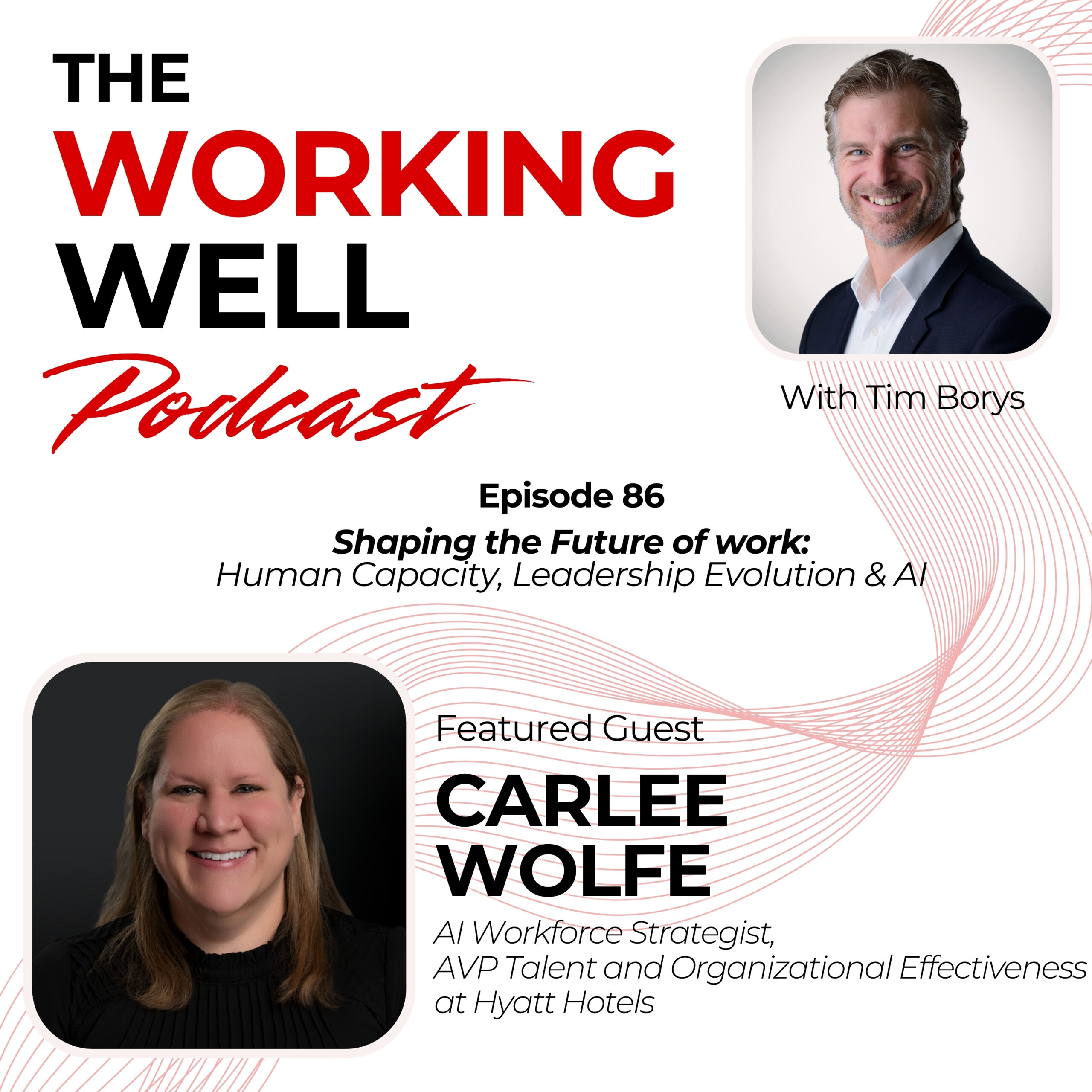
Podcast Summary
In this episode of the Working Well Podcast, Carlee Wolfe explores one of the most pressing questions of our time: How do we integrate AI without losing what makes us human?
Carlee reframes artificial intelligence not as a plug-and-play solution, but as “moldable clay” — a tool that amplifies intention, leadership clarity, and cultural design. Rather than focusing on fear-based narratives about automation replacing jobs, she highlights how AI expands capacity when organizations rethink skills, learning models, and performance systems.
From AI-driven hiring and internal skill marketplaces to redefining human differentiation in an automated world, Carlee outlines how leaders can build adaptive, future-ready teams. The conversation bridges technology, leadership psychology, and workforce transformation — offering practical guidance for navigating the AI era with both strategic rigor and human intelligence.
This episode is essential listening for leaders, HR innovators, and professionals preparing for a world where performance is no longer about hours worked — but capacity unlocked.
✅ Key Takeaways
AI is moldable clay. Its impact depends entirely on leadership intention and system design.
Capacity > productivity. AI expands human capability when aligned with strategy.
Human differentiation matters more than ever. Creativity, judgment, and relationship-building remain irreplaceable.
Learning must evolve. Skill marketplaces and internal mobility will redefine career paths.
AI in hiring requires guardrails. Fairness and transparency must be intentional.
Culture determines tech success. AI fails in unclear or fear-driven environments.
Episode Links & Resources
Connect with Carlee Wolfe here:
Website: https://aceandarrowconsulting.com/
LinkedIn: https://www.linkedin.com/in/carleeawolfe
Podcast Highlights
Please note: This highlight is generated by a computer and may contain errors.
Introduction: AI Isn’t the Future — It’s the Present
In this episode, Carlee Wolfe joins the Working Well Podcast to unpack how AI is reshaping leadership, hiring, and human performance.
Rather than positioning AI as a threat, Carlee reframes it as a force multiplier — but only when leaders understand how to shape it responsibly.
AI as “Moldable Clay”
Carlee introduces a powerful metaphor:
“AI is moldable clay — it becomes whatever the hands shaping it decide.”
Technology itself is neutral. Its impact depends on how leaders design workflows, training, accountability, and ethical guardrails. Organizations that treat AI as a shortcut often struggle. Those that treat it as a strategic capability thrive.
Capacity vs. Productivity
One of the biggest mindset shifts Carlee highlights is moving from measuring productivity to measuring capacity.
AI doesn’t simply make tasks faster — it frees cognitive bandwidth.
The question becomes:
What do we do with that freed capacity?
Do we reinvest it into innovation?
Or do we simply demand more output?
Leaders who understand this distinction unlock sustainable performance.
The Human Advantage in an AI World
As automation expands, human differentiation becomes clearer.
Carlee points to areas where humans remain essential:
Complex judgment
Ethical decision-making
Relationship trust
Creative synthesis
Cultural leadership
AI can generate content. It cannot generate meaning.
AI in Hiring & Skill Evolution
The conversation turns toward hiring and workforce mobility. AI tools can improve sourcing, screening, and internal skill matching — but only when bias mitigation is intentional.
Carlee emphasizes that internal skill marketplaces may become more important than external recruitment.
Instead of static job descriptions, we may see fluid skill ecosystems.
Culture as the Deciding Factor
Technology adoption fails when culture is unclear.
Carlee stresses:
Psychological safety drives experimentation.
Clear leadership vision reduces AI anxiety.
Transparent communication builds trust.
AI transformation is less about tools — and more about leadership maturity.
Closing Reflection
The future of work will not be defined by machines replacing humans.
It will be defined by how humans choose to evolve alongside machines.
“AI expands what’s possible — but leadership determines what’s responsible.”