
Podcast Summary
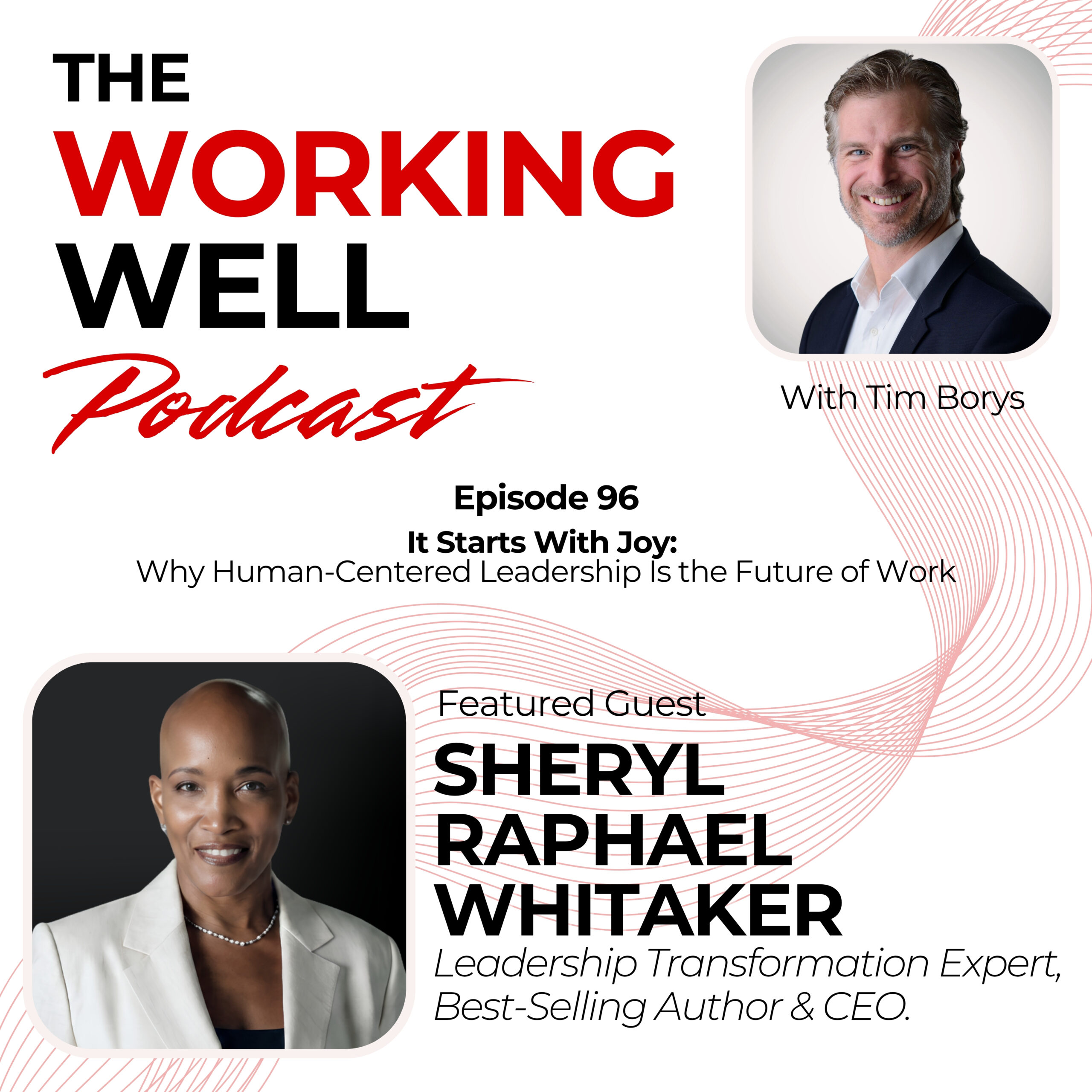
In this thought-provoking episode of the Working Well Podcast, Tim Borys welcomes leadership strategist, speaker, author, and workplace culture advocate Sheryl Raphael Whitaker for a powerful conversation about the role of joy in leadership.
At first glance, joy may seem like an unusual topic in discussions about organizational performance, transformation, and business results. But Sheryl makes a compelling case that joy is not a soft concept—it is a leadership advantage. Drawing from more than three decades of leadership experience, she explains how leading from joy creates trust, psychological safety, innovation, accountability, and sustainable performance.
The conversation explores the hidden costs of fear-based leadership, why organizations struggle to create lasting behavioral change, and how leaders can better balance business outcomes with human well-being. Sheryl shares deeply personal stories, including the experience that inspired her work, and offers a practical roadmap for leaders seeking to create cultures where people can thrive.
From burnout and disengagement to AI and the future of work, this episode challenges leaders to rethink what effective leadership looks like in an increasingly complex world.
✅ Key Takeaways
- Joy is not a soft skill—it is a leadership approach that creates trust, engagement, and sustainable performance.
- Fear-based leadership damages culture, innovation, retention, and ultimately business results.
- Organizational transformation requires behavioral change, not just leadership training programs.
- The future of work will require leaders to become even more human as AI takes over more transactional work.
- Leaders must create environments where people feel safe enough to speak honestly instead of having “the meeting after the meeting.”
- Sustainable business performance happens when organizations balance results with genuine human well-being.
Episode Links & Resources
Connect with Sheryl Raphael Whitaker here:
Website: https://www.edenanthonyelitetalent.com
LinkedIn: https://www.linkedin.com/in/sheryl-raphael-whitaker
Podcast Highlights
Please note: This highlight is generated by a computer and may contain errors.
Why Joy Matters More Than Ever
Leadership today is harder than ever.
Organizations face constant disruption, budget pressures, layoffs, changing workforce expectations, declining engagement, and increasing burnout. Amid all of this uncertainty, Sheryl Raphael Whitaker believes leaders have become disconnected from themselves.
Her answer isn’t another leadership framework or productivity system.
It’s joy.
“I was always at my best, steadfast and sure, if I led from that place of joy.”
Rather than viewing joy as a reward that comes after success, Sheryl sees it as a leadership foundation that influences how leaders show up, connect with others, and navigate challenges.
The Leadership Crisis We Don’t Talk About
One of the most powerful themes in the conversation is the growing disengagement among leaders themselves.
Organizations often focus on employee engagement scores, but leaders are increasingly exhausted, overwhelmed, and burned out.
As Sheryl points out, the very people responsible for leading transformation are often struggling the most.
When leaders become disconnected, entire organizations feel the impact.
“How are we supposed to move organizations and teams into the future if we’re stressed, burned out, and tired?”
The challenge is not simply operational.
It’s human.
When Joy Came Under Attack
For much of her life, joy was simply part of who Sheryl was.
That changed when she encountered a deeply toxic leader she refers to as “Janet.”
The experience was more than frustrating—it became physically damaging.
Living with multiple sclerosis, the stress became severe enough that her neurologist warned her about the long-term consequences.
Her hands shook.
Her health deteriorated.
Her confidence was challenged.
Most importantly, her joy was threatened.
“It was the first time in my life where my joy was ambushed.”
That experience ultimately became the catalyst for her work helping leaders understand the consequences of fear-based leadership.
Fear-Based Leadership Creates Fear-Based Cultures
Throughout the conversation, Sheryl repeatedly returns to a simple truth:
Leaders create the emotional environment of their organizations.
When leaders operate from fear, organizations become fearful.
When leaders operate from trust, people become more willing to contribute fully.
Fear-based cultures often create:
- Silence
- Politics
- Hidden problems
- Defensive behavior
- Reduced innovation
- Employee disengagement
The result is what Sheryl calls “the meeting after the meeting.”
Everyone nods in agreement during the official meeting.
Then the real conversation happens afterward.
“Decisions never really happen because people are afraid.”
Joyful leadership creates the opposite effect.
People speak honestly.
Concerns surface earlier.
Innovation increases.
Trust grows.
Leadership Is About People
One of the most memorable moments comes when Sheryl shares a story about a former leader who said:
“Leadership would be a perfect job if it wasn’t for the people.”
The statement left her stunned.
After all, who exactly are leaders leading if not people?
The exchange highlights a common problem in organizations.
Technical expertise often gets rewarded and promoted into leadership positions. Yet technical competence and people leadership require entirely different capabilities.
As Sheryl explains:
“You are a people leader. The work gets done through people.”
The distinction becomes increasingly important as organizations navigate change, complexity, and workforce transformation.
AI Makes Human Leadership More Important
Contrary to popular belief, Sheryl argues that AI actually increases the importance of human leadership.
As technology automates tasks and processes, leaders must focus more intentionally on:
- Relationships
- Communication
- Trust
- Team dynamics
- Emotional intelligence
- Human connection
The future of work isn’t less human.
It’s more human.
“With AI, now I really have to focus on the human.”
The leaders who develop these capabilities will be better equipped to navigate the changing workplace landscape.
Why Leadership Development Often Fails
Organizations spend billions on leadership development.
Yet many leaders still struggle to transform their behavior.
Why?
According to Sheryl, the problem isn’t lack of training.
It’s lack of transformation.
Many organizations focus on delivering information rather than changing behavior.
Workshops happen.
Training happens.
Knowledge is transferred.
Then everyone returns to old habits.
“They are developing leaders, but leaders are not transforming.”
Real leadership growth requires accountability, reflection, practice, and time.
Behavioral change cannot be rushed.
Healthy Leadership Threatens Unhealthy Cultures
One of the most fascinating parts of the conversation explores why healthy leadership often encounters resistance.
The answer?
Identity.
Many leaders achieved success using a particular leadership style. Asking them to change can feel like challenging their entire professional identity.
“It’s an identity crisis.”
For organizations, this often creates a system that protects dysfunction.
The behaviors may no longer work.
The culture may be unhealthy.
But change feels risky.
And fear keeps the cycle alive.
The Future of Work Starts With Conversation
When asked what leaders can do immediately, Sheryl’s answer is surprisingly simple:
Start talking.
Have real conversations.
Ask people how they’re doing.
Ask where they want to go.
Ask what they need.
Listen.
“It starts with a conversation.”
The future of work, she argues, will be built through honesty, vulnerability, accountability, and human connection.
Not slogans.
Not surveys.
Not initiatives.
Conversations.
Final Thoughts
This episode challenges one of the biggest misconceptions in leadership:
That business performance and human well-being are somehow competing priorities.
Sheryl Raphael Whitaker makes a compelling case that the opposite is true.
Organizations that prioritize human flourishing create stronger engagement, healthier cultures, better decisions, and ultimately stronger business results.
Joy is not the absence of accountability.
Joy is not avoiding hard conversations.
Joy is not lowering standards.
Instead, joy creates the conditions that allow people to do their best work.
And in a future increasingly shaped by technology, that may become one of the most valuable leadership capabilities of all.