
Podcast Summary
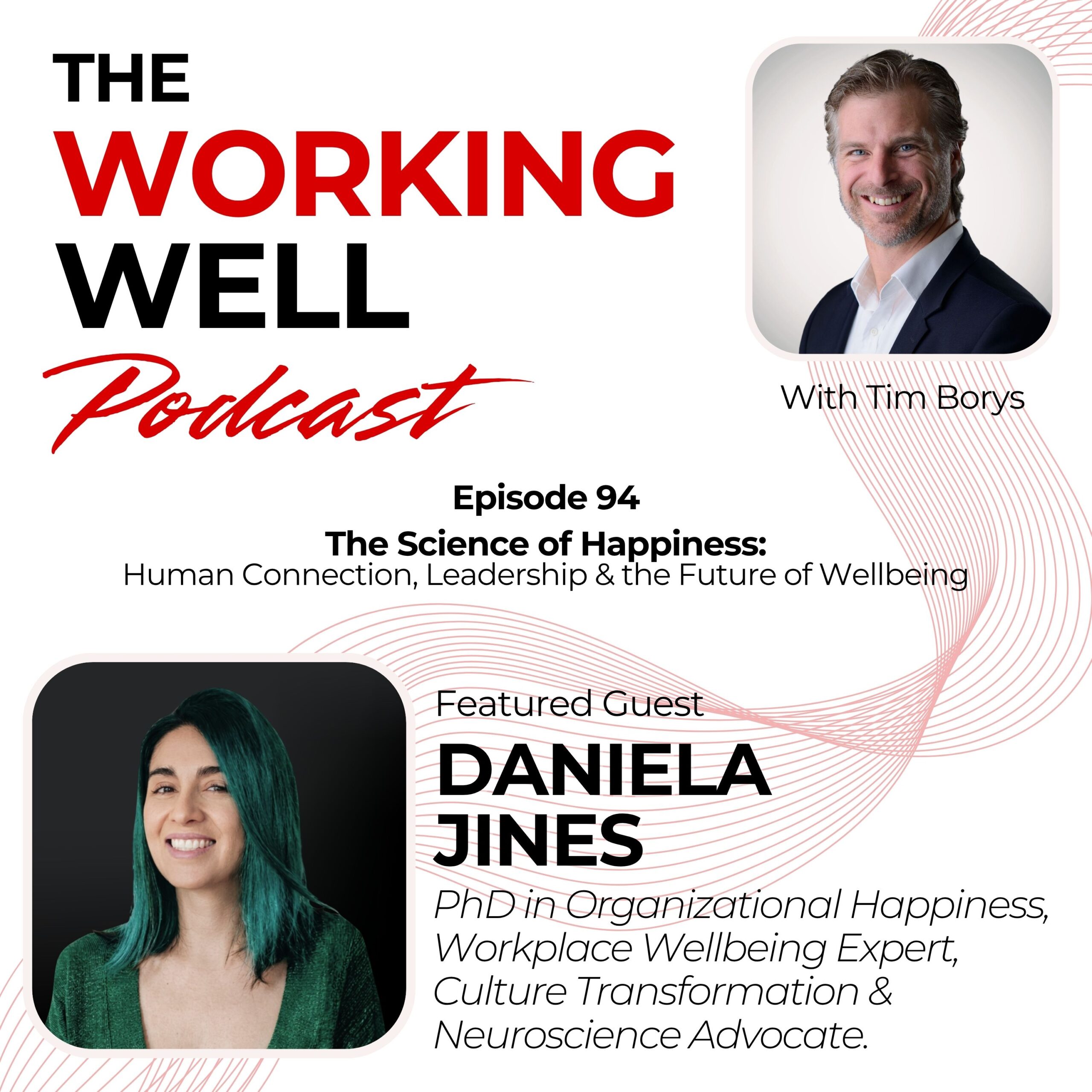
In this episode of the Working Well Podcast, Tim Borys sits down with Daniela Jines to explore what happiness at work really means, not as a feel-good concept, but as a measurable factor influencing performance, health, and organizational success.
Daniela challenges the traditional belief that productivity comes from longer hours and constant pressure. Drawing from neuroscience, workplace research, and organizational psychology, she explains how nervous system regulation, connection, purpose, and healthy workplace design directly impact how people perform.
The conversation explores why many organizations still operate on outdated industrial-era assumptions, why leaders must take ownership of culture, and how simple human behaviors like knowing employees’ names, showing vulnerability, and creating trust can dramatically change workplace outcomes.
Daniela also discusses AI’s growing role in the employee experience, highlighting the opportunities technology creates while emphasizing that human connection remains essential. She shares why the future of work is not only about efficiency it is about creating environments where people can thrive.
This episode is a powerful conversation about redefining success: balancing performance, purpose, health, and humanity.
✅ Key Takeaways
- Happiness at work is a performance factor, not a distraction. A regulated nervous system supports creativity, decision-making, and productivity.
- Culture starts with leaders. Wellbeing cannot be delegated to one department it is shaped by everyday leadership behavior.
- Connection creates loyalty. Small actions like knowing employees’ names and showing appreciation build trust.
- Rest can improve performance. Research around reduced work hours shows that recovery and balance can increase productivity.
- AI must enhance humanity, not replace connection. Technology can improve work, but humans still need relationships and belonging.
- Self-awareness transforms leadership. Leaders willing to receive feedback and show vulnerability create stronger teams.
Episode Links & Resources
Connect with Daniela Jines here:
Website: https://happyorganizations.org
LinkedIn: https://www.linkedin.com/in/daniela-jines
Podcast Highlights
Please note: This highlight is generated by a computer and may contain errors.
Introduction: Rethinking Happiness at Work
We spend a significant portion of our lives working, yet many workplaces still operate under outdated assumptions about productivity.
Daniela Jines joins Tim Borys to discuss why happiness at work is not about making work easier it is about creating the conditions where people can perform at their best.
She explains that from a scientific perspective, happiness involves a calmer nervous system, stronger emotional regulation, and the ability to access our full capabilities.
Happiness Is Not the Opposite of Productivity
One common misconception is that happy workplaces are less productive. Daniela challenges this idea. When people feel psychologically safe, connected, and aligned with purpose, they are able to think more clearly, collaborate better, and perform at a higher level.
A strong culture built around mission, vision, and shared values can directly influence productivity because people understand what they are contributing toward.
The Problem With the Old Work Model
Many organizations still carry assumptions from the industrial era measuring contribution through time spent rather than value created.
Daniela explains that constantly pushing people into high-pressure states can create long-term consequences:
- Chronic stress
- Burnout
- Reduced connection
- Health challenges
She argues that the future of work requires moving away from “more hours equals more results” thinking.
The Science Behind Rest and Recovery
The conversation explores alternative work models, including research around shorter workdays.
Daniela explains that experiments with reduced work hours have shown improvements in areas such as:
- Lower sick days
- Reduced stress
- Better employee wellbeing
The key is not simply reducing hours it is understanding how people recover and return with greater capacity.
Leadership Creates Culture
Daniela emphasizes that wellbeing is not an HR initiative alone. Leaders influence culture every day through their actions.
Small behaviors can create major trust shifts:
- Knowing employees’ names
- Asking about their lives
- Showing appreciation
- Being present
Research and examples discussed in the episode highlight how these simple actions strengthen connection and loyalty.
Vulnerability Is a Leadership Strength
Many leaders were trained to believe they must always appear strong and have all the answers.
Daniela challenges that mindset. She explains that leaders who can acknowledge mistakes, receive feedback, and apologize build deeper trust because people see them as human.
AI and the Future of Human Connection
AI is changing how organizations operate.
Daniela believes AI should be celebrated for the ways it improves human life, but warns that technology cannot replace fundamental human needs.
People still need:
- Connection
- Belonging
- Relationships
- Meaning
When technology removes too much human interaction, organizations risk weakening the very things that help people thrive.
What Matters Most
After traveling and speaking with people around the world, Daniela found that many people ultimately want similar things:
- Happiness
- Connection
- Time with loved ones
- Purpose
- A sense that their life matters
Success is not only measured by achievement it is also measured by the quality of life we create.
Final Thoughts
The future of work is not just about becoming faster, more efficient, or more technologically advanced it is about becoming more human. Daniela Jines reminds us that true workplace wellbeing starts with connection, purpose, and intentional leadership. Happiness is not a distraction from performance; it is one of the foundations that allows people and organizations to thrive.
As technology and AI continue to transform the way we work, the greatest advantage we have will remain uniquely human: our ability to connect, care, collaborate, and create meaning. The leaders and organizations that succeed will be those who understand that when people feel valued, supported, and connected performance naturally follows.