Podcast Summary
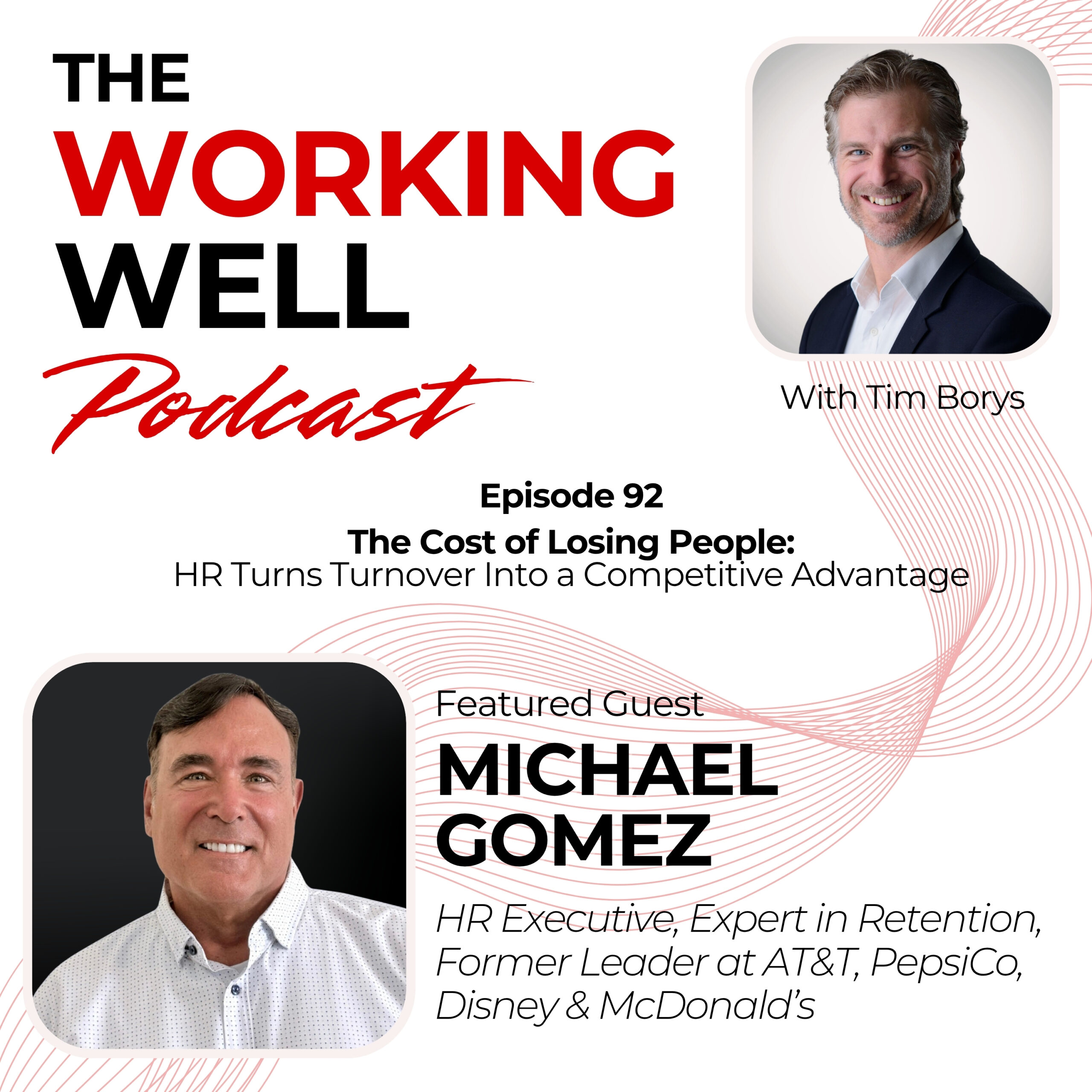
In this episode of the Working Well Podcast, Tim Borys sits down with HR executive and organizational leadership expert Michael Gomez for a deep dive into employee retention, leadership effectiveness, organizational culture, and workforce development in high-turnover industries.
Drawing from decades of leadership experience across major organizations and multi-unit restaurant operations, Michael breaks down why retention is one of the most misunderstood and financially impactful areas of business performance. From compensation and benefits to leadership behaviors, performance systems, AI-driven hiring, and employee development, this conversation explores what actually creates long-term workforce stability.
Michael shares practical examples from large-scale QSR operations, including how strategic benefits programs, servant leadership, learning systems, performance planning, and transparent development processes can dramatically reduce turnover while improving operational performance.
The conversation also explores the future of AI in HR, why employee experience directly impacts customer experience, and how leaders can create cultures where people genuinely want to stay, grow, and contribute.
This episode is packed with actionable leadership insights for executives, HR professionals, founders, and people leaders looking to build stronger teams, healthier cultures, and more sustainable organizational growth.
✅ Key Takeaways
- Retention is not driven by one factor compensation, development, leadership, recognition, and culture all multiply together.
- Employees don’t leave companies as often as they leave ineffective leadership.
- High-performing organizations create transparent systems for development, accountability, and feedback.
- Micro-learning and just-in-time training dramatically improve implementation and employee engagement.
- AI can remove administrative burden from leaders and improve hiring speed, efficiency, and candidate quality.
- Clear expectations and ongoing developmental conversations create trust, stability, and long-term retention.
Episode Links & Resources
Connect with Michael Gomez here:
Website: https://www.mgidelivers.com
LinkedIn: https://www.linkedin.com/in/michael-gomez
Podcast Highlights
Please note: This highlight is generated by a computer and may contain errors.
Why Retention Is a Leadership Issue Not Just an HR Metric
Employee retention has become one of the defining challenges facing modern organizations. For Michael Gomez, retention is far more than an HR KPI it’s a direct reflection of leadership quality, operational systems, culture, and organizational clarity.
“If you get retention right, you’re winning big. If you don’t, you’re really paying the price.”
In industries like quick-service restaurants (QSR), where turnover rates can exceed 100% annually, the financial consequences are massive. Recruiting, onboarding, retraining, productivity loss, and operational instability all compound quickly. But Michael argues that turnover is not inevitable. The organizations that outperform competitors in retention tend to approach people systems with the same rigor they apply to operations, customer experience, and profitability.
Retention Is Built on Multiple Interdependent Factors
One of the strongest themes throughout the conversation was that retention is never solved through a single initiative. Compensation matters. Benefits matter. Leadership matters. Development matters. Recognition matters.
And most importantly, these factors multiply together.
“Two times two times zero equals zero. You have to get them all right.”
Michael emphasized that organizations often underestimate how deeply affordability and benefits influence employee stability especially among lower-income frontline workers. Post-pandemic realities have also shifted workforce expectations significantly.
Mental health challenges, financial stress, healthcare access, and economic uncertainty now play a larger role in retention than many organizations acknowledge. Companies that ignore those realities risk losing people regardless of how strong their operational systems may be.
What High-Performing Organizations Actually Do Differently
Throughout the episode, Michael repeatedly pointed to operational discipline as a defining characteristic of high-retention organizations. The best organizations are process-driven, training-driven, and customer-obsessed. Using brands like In-N-Out and Chick-fil-A as examples, he described environments where:
- Training systems are highly structured
- Standards are consistently reinforced
- Employee development is visible
- Skill progression is clearly defined
- Customer experience is intentionally engineered
What stood out most was how employee experience and customer experience were treated as inseparable.
“Employee satisfaction comes before customer satisfaction.”
When employees feel supported, trained, developed, and respected, they naturally create stronger customer experiences. When they feel neglected or unsupported, the customer ultimately feels it too.
Empowerment Does Not Mean Abandonment
One of the most practical leadership lessons from the episode centered around the misuse of empowerment. Michael explained that many leaders misunderstand delegation and assume empowerment means giving employees freedom without support.
But unsupported employees don’t feel empowered they feel abandoned.
“Empowerment doesn’t equal abandonment.”
Strong leaders assess both motivation and capability. If an employee is motivated but lacks skill, leadership must provide coaching and development. If leaders simply hand off responsibility without support, failure becomes almost inevitable.
This is where leadership becomes highly practical. The role of a manager is not simply assigning tasks, it’s ensuring people have the clarity, training, confidence, and reinforcement necessary to succeed.
Why Development Conversations Matter More Than Most Leaders Realize
A major frustration Tim highlighted throughout the conversation was how many leaders still fail to have genuine development conversations with employees. Many one-on-one meetings become tactical check-ins focused entirely on projects, deadlines, and operational updates.
What often gets ignored are questions like:
- Where do you want to grow?
- What skills do you want to develop?
- What motivates you?
- What would make your work more meaningful?
Michael stressed that development must become part of the organizational process — not an occasional conversation.
“People want to know how much you care before they care how much you know.”
He described systems where employees actively participate in evaluating their strengths, opportunities, and future growth plans alongside supervisors. These collaborative development processes increase engagement, trust, and long-term retention because employees feel seen as people not just labor.
The Power of Pattern Creation in Leadership
One of the more unique concepts Michael introduced was the idea of “pattern creation.”
Strong cultures are built through predictable, repeatable leadership systems:
- Performance planning at the beginning of the year
- Mid-year calibrations
- Regular development conversations
- Transparent performance reviews
- Ongoing employee feedback systems
Over time, these processes create organizational stability. Employees know what to expect.
They understand how success is measured.
They trust the system.
And trust creates retention.
“People want to know where the bar is.”
Without clarity, employees become disengaged, anxious, or resentful — especially when reviews or feedback feel inconsistent or surprising.
AI Is Reshaping Workforce Operations
The conversation also explored the growing role of AI in HR and workforce systems. Michael encouraged leaders to embrace AI quickly rather than resist it.
Using Paradox AI as an example, he described how automation streamlined recruiting workflows across six brands and dramatically improved hiring speed and candidate flow.
Administrative tasks like:
- Interview scheduling
- Candidate communication
- Background checks
- Application management
were automated, freeing leaders to spend more time building stronger teams.
“The group of people coming into the workforce now — they have higher expectations.”
Modern employees expect speed, efficiency, responsiveness, and streamlined communication. Organizations still relying on outdated hiring systems risk losing talent before conversations even begin.
Culture Is Created Through Daily Leadership Behaviors
At the highest level, Michael framed culture as the outcome of repeated leadership behaviors.
Organizations must intentionally define:
- What they value
- How employees are supported
- What customer experience means
- How performance is measured
- How people are developed
He repeatedly returned to servant leadership as a foundational philosophy.
The best leaders support the people closest to the customer.
They coach.
They facilitate.
They remove obstacles.
And they genuinely care about helping employees succeed.
“People generally want to feel good about serving others.”
The leaders who understand this build cultures where employees stay longer, perform better, and create stronger customer experiences naturally.
Final Thoughts
This conversation was ultimately a masterclass on operational leadership through the lens of people. Michael Gomez makes a compelling argument that retention is not about perks or slogans it’s about systems, leadership consistency, development, accountability, and care.
Organizations that treat employee experience as a strategic priority create stronger cultures, better customer experiences, and healthier long-term business performance. And in a world where turnover, disengagement, and burnout continue to rise, those capabilities may become one of the greatest competitive advantages a business can build.