
Podcast Summary
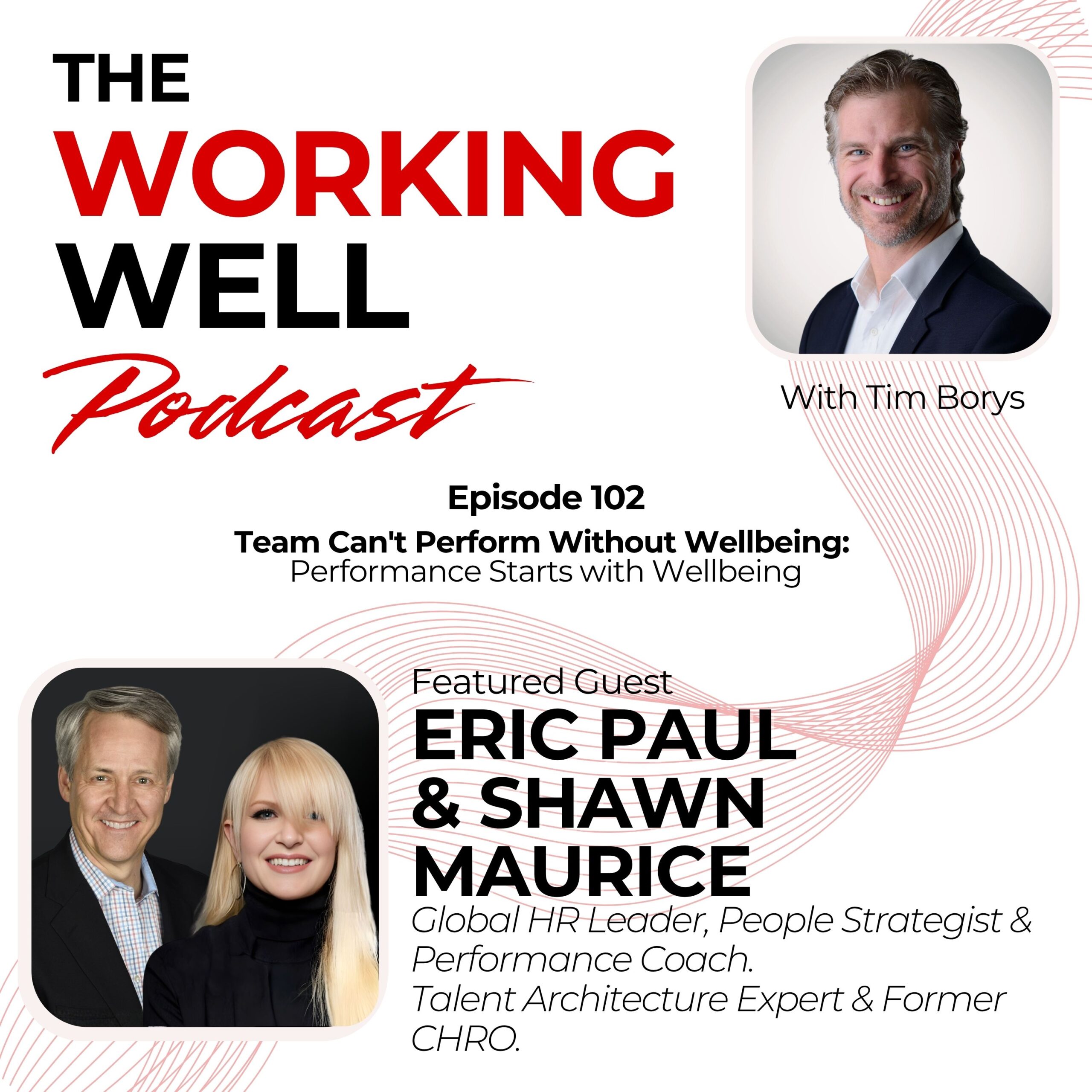
In this episode of the Working Well Podcast, host Tim sits down with Eric and Shawn two veteran HR and talent leaders with a combined 60+ years inside Fortune 100 and global technology organizations. Longtime friends and colleagues, Eric and Sean bring a rare combination of C-suite credibility and hands-on coaching experience to a conversation that cuts through the “fluffy” reputation well-being conversations often carry in the boardroom.
The discussion centers on a simple but under-examined idea: capability isn’t sustainable without wellness. Eric and Sean unpack why high performance is really the intersection of capability and wellness, why leaders are the primary role models for healthy (or unhealthy) work behavior, and why the disruption of AI makes stress resilience more business-critical than ever not less.
Using vivid analogies (marathons vs. sprints, race cars vs. rally courses, corporate athletes and their coaches), the conversation moves from big-picture organizational strategy down to the practical, individual level: what a one-on-one should really accomplish, how leaders unintentionally model burnout, and why organizations that treat wellness as a checkbox program (EAPs, yoga classes) rather than a leadership behavior will keep losing the engagement battle.
For HR leaders, executives, and anyone responsible for team performance, this episode offers a strategic reframe: wellbeing and performance aren’t competing priorities they’re the same system. As AI reshapes how work gets done, Eric and Sean argue the organizations that win will be the ones who treat their people not just their technology as the core competitive advantage.
✅ Key Takeaways
- Capability without wellness doesn’t scale. Leadership capability, team performance, and organizational structure all eventually collapse if the people running them aren’t well — physically or mentally. Wellness isn’t a “nice to have”; it’s a business continuity issue.
- Leaders are role models whether they intend to be or not. If a leader works until 6:30pm on a Friday or sends emails all Sunday night, their team will mimic that behavior even at personal cost simply because it signals what’s “valued.”
- Disengagement has a dollar figure attached. Global disengagement costs are estimated at $440 billion, with an additional $411 billion lost to inadequate sleep reframing wellness from an HR “soft” topic into a hard P&L conversation.
- Stress resilience is now a core leadership skill, not a bonus one. In a world where “change management is something we do every minute of every day,” the ability to adapt under pressure is as important as technical or strategic skill.
- AI should be additive, not just reductive. The IKEA example redeploying 8,500 customer service roles into interior design consulting and adding $1 billion in revenue shows how reskilling can create new value instead of simply cutting headcount.
- Individual, leader, and organization form one connected system. Real, sustainable performance requires all three levels self-management, team leadership, and organizational culture/structure to be aligned; most companies only get one or two right.
Episode Links & Resources
Connect with Eric Paul & Shawn Maurice:
LinkedIn (Eric): https://www.linkedin.com/in/ericpaultalentmgmt
LinkedIn (Shawn): https://www.linkedin.com/in/shawn-maurice
Podcast Highlights
Please note: This highlight is generated by a computer and may contain errors.
Why Wellness Is a Business Issue, Not a “Nice to Have”
Tim opened by asking Eric and Sean to reflect on what nearly 20 years inside large, complex organizations taught them about the connection between leadership, well-being, and performance.
Eric didn’t hesitate:
“Capability isn’t sustainable without wellness… it’s not a nice-to-have, it’s a need-to-have conversation.”
He compared it to running a sprint versus a marathon you can push hard for a moment, but if leaders and teams aren’t secure in their wellness, “the enterprise performance ultimately crumbles.”
Sean built on that, framing high performance itself as a combination that’s rarely defined properly: capability and wellness, together. He pointed to sobering data only about 36% of people report feeling like they’re thriving at work, and anxiety and depression now rank among the top three health issues in the workplace, behind only heart disease and diabetes.
The Leadership Stress Paradox
Tim referenced Deloitte’s State of the Workplace research, noting that leaders often report higher stress levels than their own teams — a dangerous dynamic, since a stressed leader struggles to help others thrive.
Eric agreed, and added a second layer: leaders are role models whether they realize it or not.
“If you’re not showing the behaviors that you need to your team members, they’re going to follow what they see.”
He shared a story about “Octavio,” a senior regional leader in Latin America who regularly worked until 6:30pm on Fridays, unaware that his entire floor stayed late simply because he hadn’t left yet. When Eric convinced Octavio to leave early and park his car around the corner so employees wouldn’t see it, “every car that was left in the parking lot exited” within two minutes.
The lesson: leadership behavior working late, sending Sunday-night emails sets an implicit standard that teams feel obligated to match, even when it’s not healthy for them.
Reframing Wellness as a Dollars-and-Cents Conversation
Many executives dismiss wellness conversations as “fluffy,” Eric acknowledged — pointing to Employee Assistance Programs (EAPs) as evidence they’ve “already handled it.” His counter is to bring the data: global disengagement costs roughly $440 billion, and RAND estimates $411 billion is lost annually due to inadequate sleep.
“There is a cost to this, and as a leader you are a role model in setting the right behavior.”
Defining Wellness, Well-Being, and Performance
Tim asked the pair to draw a clear distinction between three terms often used interchangeably. Sean described wellness through a pyramid of human needs — physical, intellectual, financial, social, and spiritual — arguing leaders must see people holistically rather than isolating “engagement” from “wellness.”
Eric summarized it crisply: performance is the outcome of wellness and well-being working in harmony. Tim added his own framing — wellness as the tactical inputs (sleep, exercise, nutrition), well-being as the resulting state of thriving, and performance as the downstream business result.
The One-on-One as a Wellness Tool
Eric traced his own leadership education back to Intel, where Andy Grove personally taught incoming employees the purpose of the weekly one-on-one: an employee-owned meeting to surface not just project status, but personal circumstances affecting work — and where they need support.
“It’s more than an academic conversation. It really does land in the dollars-and-cents side.”
Corporate Athletes: Training, Feedback, and Adjustment
Sean shared his own experience taking up trail running and hiring a coach — an analogy for how leaders should approach their teams. His coach’s first question wasn’t about training plans; it was “What do you want to do?” From there came a structured plan: running, weight, nutrition — followed by consistent review of data, splits, and how he felt, then adjustment.
“It’s a consistent process of communicating, planning, adjusting, retraining… but it’s iterating at a speed which is faster than I think most leaders have been familiar with in the past.”
Eric connected this to the concept of VUCA (volatile, uncertain, complex, ambiguous) environments now “VUCA on steroids” thanks to AI and referenced a Duke women’s basketball coach’s phrase that stuck with him: learning to “handle hard well.”
Three Spheres of Accountability
Tim proposed a framework of three interconnected spheres: the individual (owning day-to-day performance and health), the leader (responsible for how their team shows up), and the organization (building the systems, structure, and culture that operationalize sustainable performance). His observation: these three rarely connect inside real companies — individuals and pockets of good leadership exist, but organizational systems rarely reinforce them.
Eric echoed this with his own Venn diagram of individual, leader, and organization, each with escalating responsibility — the C-suite in particular must model health and design the vision, mission, structure, and reward systems that make wellness possible at scale.
“If you don’t have a healthy workforce, you don’t have a healthy company. Bottom line.”
AI: Augmentation, Not Just Automation
The conversation turned to AI’s role in this equation. Sean warned against adopting AI for its own sake, arguing that transformation should be designed backward from customer value — not driven purely by IT or governance concerns.
Eric added a widely-cited example: IKEA’s 2022–2023 replacement of roughly 8,500 customer service roles with an AI chatbot. Rather than eliminating those employees, IKEA retrained many into interior design consultation roles — a shift that reportedly added $1 billion in annual revenue.
“AI will replace some jobs, but it doesn’t mean we need to just cut those people from the payroll… it’s additive versus reductive.”
Both agreed that whether AI transformation is led by HR or by IT matters — because at its core, this is a people transformation, not just a technology one.
Closing: The Wallet Test
Shawn closed with a story about one of the best leaders he ever worked for a man who carried a small, crumpled piece of paper in his wallet for 20 years. Each morning he’d ask himself what kind of leader he wanted to be that day; each evening, whether he’d lived up to it.
“If those come together, then you’ve done the greatest job as a leader as you can.”
Eric’s parting framework distilled the conversation into three action items for leaders: build awareness of the health-performance link at the C-suite, set a culture where wellness is expected rather than optional, and become each employee’s “check engine light” catching issues before they become crises.
Shawn final word reinforced the episode’s core thesis: AI will create enormous capability gains, but only for organizations that first believe people are the competitive advantage with machines as collaborators, not replacements.