
Podcast Summary
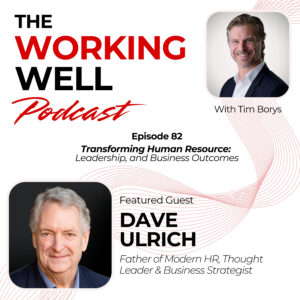
In this episode of the Working Well Podcast, Tim Borys is joined by Dave Ulrich, one of the world’s most influential thinkers on leadership, human resources, and organizational effectiveness.
Dave challenges traditional views of HR and leadership, arguing that the true role of people leaders is not activity, programs, or policies but creating measurable value for customers, investors, employees, and communities. He explains why HR must move beyond administrative work toward strategic impact, while still mastering both sides of the equation.
The conversation explores why employee wellbeing, engagement, and leadership development only matter when they connect directly to business outcomes. Dave shares practical frameworks for navigating leadership paradoxes such as caring deeply about people and competing aggressively in the marketplace and explains why leaders must model the behaviours they want to see rather than demand them.
Tim and Dave also discuss the role of AI in leadership and HR, the limits of benchmarking, and why differentiation not data parity is what creates long-term success. The episode closes with a powerful reminder: without success in the marketplace, there is no workplace.
✅ Key Takeaways
HR must focus on business outcomes, not just programs or activity
Employee engagement strongly correlates with customer engagement and revenue
Leaders must manage paradoxes: people and performance
You can’t demand participation you must model it
AI creates information parity; leaders win through human judgment and differentiation
The best thing you can give employees is a company that succeeds
Wellbeing initiatives must clearly connect to strategy, customers, and results
Episode Links & Resources
Connect with Dave Ulrich here:
Website: http://www.rbl.net/
LinkedIn: https://www.linkedin.com/in/daveulrichpro
Podcast Highlights
Please note: This highlight is generated by a computer and may contain errors.
Why HR Must Focus on Value, Not Activity
Many organizations measure HR by visible activity training sessions, wellness programs, engagement surveys. But activity alone doesn’t guarantee impact. The real question is whether these efforts help customers buy more, investors gain confidence, and the organization execute its strategy.
HR creates credibility when it shifts the conversation from “what we did” to “what changed.”
HR Is Both Administrative and Strategic
There’s a false belief that HR must choose between being operational or strategic. In reality, it must do both. Payroll needs to be accurate. Systems must work. Compliance matters. But those are table stakes.
What separates great HR from average HR is the ability to connect people practices to long-term value creation.
Employee Engagement Is a Business Metric
Employee engagement isn’t a feel-good measure. It’s a leading indicator of customer satisfaction, loyalty, and performance. When employees feel connected to the organization’s purpose and leadership, customers feel it in the experience they receive.
Disengagement shows up first internally but it always reaches the marketplace.
Leadership Is Modeled, Not Mandated
You cannot demand participation, wellbeing, or engagement from employees. Culture is shaped by what leaders model, not what they announce.
If leaders don’t live the behaviours they expect collaboration, learning, wellbeing, accountability those behaviours won’t stick.
Managing Paradox Is the Leader’s Job
Great leaders don’t choose between caring about people or competing in the marketplace. They do both. This paradox defines modern leadership.
Organizations that prioritize people without performance drift. Organizations that prioritize performance without people burn out. Sustainable success lives in the tension between the two.
AI Changes Information, Not Judgment
AI makes data more accessible and insights faster. But it doesn’t replace leadership judgment. Algorithms summarize the past; leaders decide the future.
When everyone has access to the same data, differentiation comes from values, choices, and how leaders apply information not from the tools themselves.
Wellbeing With Strategic Purpose
Wellbeing initiatives fail when they are disconnected from leadership behaviour and business goals. When well-being supports energy, focus, and execution, it becomes a strategic asset, not a perk.
The question isn’t whether well-being matters. It’s whether it matters to the business.
The Core Truth
Without success in the marketplace, there is no workplace. HR exists to help organizations win so people can thrive within them.