
Podcast Summary
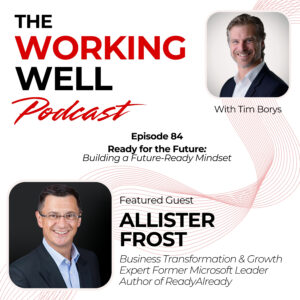
In this episode of the Working Well Podcast, Tim Borys is joined by Allister Frost for a wide-ranging conversation on change, adaptability, and what it really means to be future ready in an increasingly fast-moving world.
Allister shares how his career across traditional manufacturing and the tech sector shaped his concern about “a tsunami of obsolescence” — where people struggle to keep up as technology, expectations, and work accelerate. Rather than positioning change as something that happens to us, he reframes it as something individuals can actively create for themselves.
The discussion introduces Alister’s concept of the future-ready mindset, which builds on growth mindset by adding purpose, agency, and practical action. He explains why small, continuous improvements matter more than large, top-down change programs, and why real transformation happens when individuals take ownership of their learning and ideas.
They also explore the uniquely human capabilities technology can’t replace curiosity, imagination, and storytelling and why leaders must create environments where these qualities are encouraged. The episode closes with a powerful reminder: change isn’t the enemy fear of loss is and those who embrace curiosity and responsibility can thrive at any stage of their career.
✅ Key Takeaways
Being “today-ready” is an achievement, but being future-ready requires space to think ahead
Continuous small improvements drive real organizational change
Fear of loss, not change itself, is what people resist
Growth mindset alone isn’t enough without purpose and agency
Curiosity, imagination, and collaboration are uniquely human advantages
Individuals, not just leaders, are responsible for shaping the future
- Change isn’t something that happens to you it’s something you can create
Episode Links & Resources
Connect with Allister Frost here:
Website: https://allisterspeaks.com/
LinkedIn: https://www.linkedin.com/in/allisterspeaks
Podcast Highlights
Please note: This highlight is generated by a computer and may contain errors.
Introduction: Why Mindset Matters More Than Ever
In this episode, Allister Frost joins the Working Well Podcast to explore the psychology of change in a rapidly evolving world.
Drawing from his leadership experience at Microsoft and his work advising global organizations, Allister explains that while technology accelerates transformation, human thinking often lags behind.
The future, he says, belongs to those willing to evolve internally as quickly as the world evolves externally.
The Future-Ready Mindset
Allister introduces the idea of being “future-ready” not as a skill set, but as a mindset.
A future-ready individual:
Stays curious
Experiments frequently
Embraces ambiguity
Sees change as opportunity
Rather than clinging to past successes, they continually ask: What might be possible next?
Curiosity as Competitive Advantage
Curiosity, according to Allister, is no longer optional.
Organizations that encourage questioning outperform those that reward certainty. Leaders who model learning create cultures where innovation thrives.
“The quality of your future is shaped by the quality of the questions you ask today.”
Curiosity opens doors that fear keeps closed.
Courage Over Comfort
Allister and Tim discuss how comfort zones become invisible cages.
Growth requires stepping into uncertainty not recklessly, but intentionally.
Experimentation doesn’t mean massive risk. It means small, repeatable trials that create forward motion. Progress compounds.
The Power of Imagination
Imagination isn’t childish — it’s strategic.
Allister explains that the ability to imagine alternative futures allows leaders to anticipate disruption rather than react to it.
Future-ready leaders rehearse tomorrow before it arrives.
Practical Habits for Adaptability
Allister shares actionable approaches for building resilience:
Schedule time for learning.
Celebrate intelligent failure.
Reframe setbacks as data.
Surround yourself with diverse thinkers.
Regularly ask, “What would we try if we weren’t afraid?”
These micro-habits create macro-results.
Closing Reflection
The future isn’t fixed — it’s flexible.
“You don’t wait for the future. You create it.”
Allister leaves listeners with a powerful reminder: optimism is not naive — it’s strategic.