
Podcast Summary
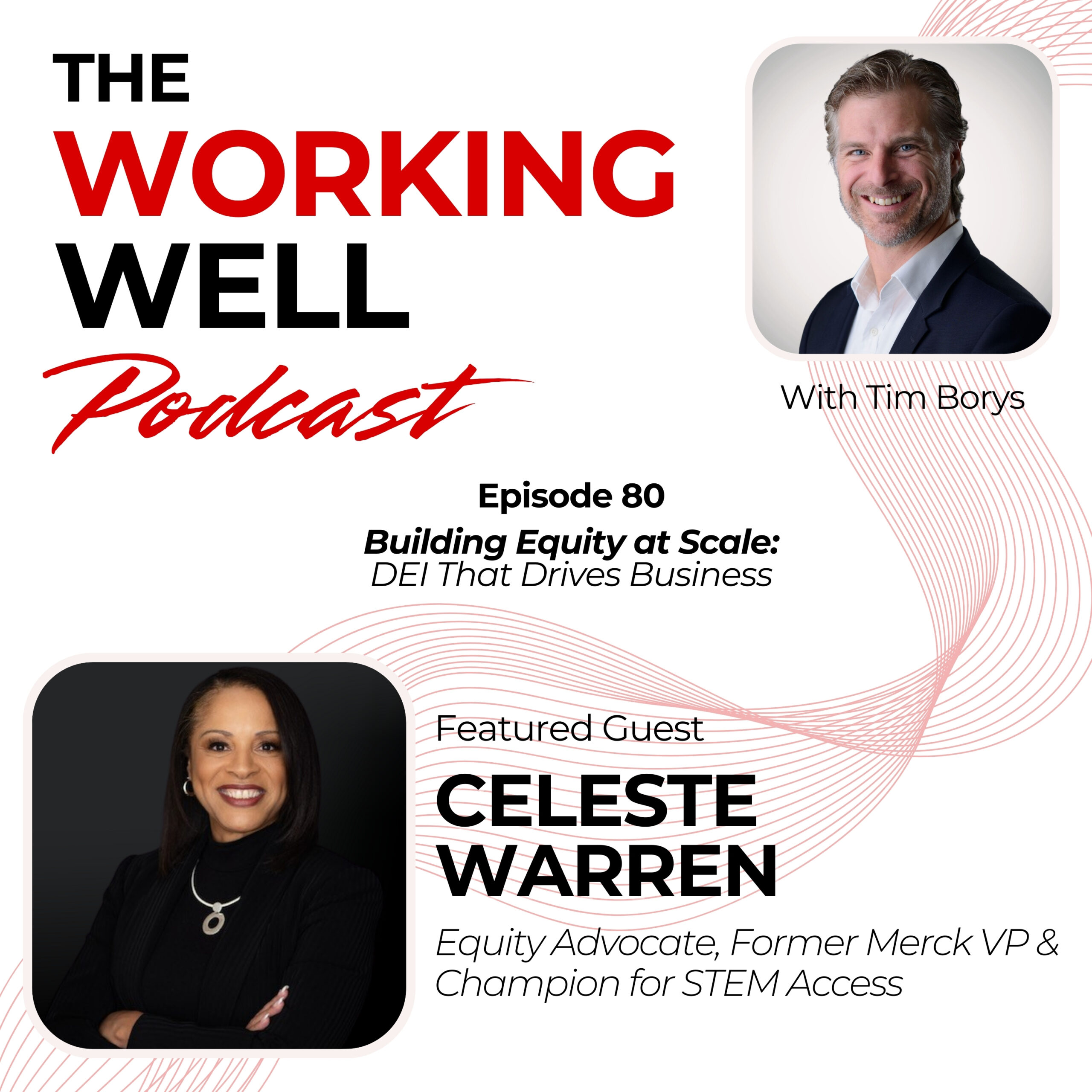
In this episode of the Working Well Podcast, host Tim Borys sits down with Celeste Warren, former Vice President & Global Chief Diversity and Inclusion Officer at Merck, where she spent nearly three decades driving culture transformation, advancing inclusion, and shaping talent strategy across a global workforce.
Celeste is also the author of The Truth About Equity and founder of Destination STEM, a nonprofit committed to building more accessible STEM opportunities for underrepresented communities.
In this conversation, Celeste explains why organizations can’t treat DEI as a project or initiative — it must be embedded into leadership accountability, systems of work, and everyday behaviors. She breaks down how leaders can measure equity meaningfully, elevate diverse voices, redesign structures to reduce bias, and create cultures where every employee can contribute fully and thrive.
This episode is essential listening for executives, HR leaders, and managers committed to building workplaces grounded in fairness, empathy, and results.
✅ Key Takeaways
DEI must be core to business strategy. It’s not separate from performance — it directly drives innovation, profitability, and competitive advantage.
Equity is measurable. With the right metrics, organizations can see real progress in representation, experience, and outcomes.
Leaders must own DEI personally. Culture follows behavior — employees mirror what leadership rewards, acknowledges, and models.
Systems matter. Without structural change, DEI becomes symbolic; with it, inclusion becomes sustainable.
Everyone has a role. Culture is not “an HR program” — every employee contributes to the ecosystem daily.
Equity fosters engagement. When people feel seen, respected, and empowered, performance goes up at every level.
Episode Links & Resources
Connect with Celeste here:
Website: https://crwdiversity.com/
https://destinationstem.org
LinkedIn: https://www.linkedin.com/in/celeste-warren-she-her-3728784/
Podcast Highlights
Please note: This highlight is generated by a computer and may contain errors.
Introduction — DEI as a Business Imperative
The episode opens with Tim welcoming Celeste Warren, former VP and Global Chief Diversity & Inclusion Officer at Merck. Tim highlights Celeste’s 28-year career leading people strategy and culture transformation at one of the world’s largest healthcare companies.
Celeste shares how DEI has shifted from a compliance and HR function into a business necessity — one that directly drives market growth, innovation, and talent competitiveness.
How Celeste Built a Global DEI Function
Celeste describes stepping into the role at Merck when DEI was still seen as “a side initiative.” Her goal: move DEI from the margins of the organization into the center of business strategy.
This required:
Leadership alignment
Global frameworks
Measurable outcomes
Clear accountability
System-level redesign
“If you can measure sales and performance, you can measure equity.”
The Metrics That Matter
Tim asks how organizations can make DEI tangible.
Celeste explains that meaningful measurement must include:
Representation at all levels
Pay equity
Promotion velocity
Experience and belonging surveys
Access to development opportunities
Retention data
When equity gaps are visible, leaders can act.
Why DEI Fails in Some Organizations
Celeste outlines the missteps most organizations make:
Treating DEI as a temporary campaign
Expecting HR to “own it alone”
Rewarding leaders only for business results, not people results
Not changing systems, processes, and decision pathways
“Culture follows the systems you build — not the posters you put on the wall.”
Leadership Accountability
For DEI to stick, leaders must experience:
Ownership
Consequences
Coaching and support
Success visibility
Celeste explains how Merck built DEI expectations into leadership evaluations and compensation — ensuring equity wasn’t optional.
Creating Psychological Safety
Celeste discusses how diversity means nothing without environments where people feel safe:
Speaking up
Sharing ideas
Asking questions
Challenging assumptions
Psychological safety enables innovation, collaboration, and engagement.
DEI Is Everyone’s Job
Celeste stresses that employees at every level contribute to daily culture:
“You shape the environment every time you speak up, listen, or support someone who doesn’t feel like they have a voice.”
Small actions change ecosystems.
From the Boardroom to the Break Room
Tim and Celeste explore examples of DEI working well — from frontline manufacturing sites to global leadership councils.
When systems are aligned, equity becomes:
Scalable
Measurable
Self-reinforcing
Final Insights
Celeste ends with a challenge to leaders:
“Ask yourself every day: Who felt seen, heard, and supported because I was in the room?”
That is how leadership impact is measured.