
Podcast Summary
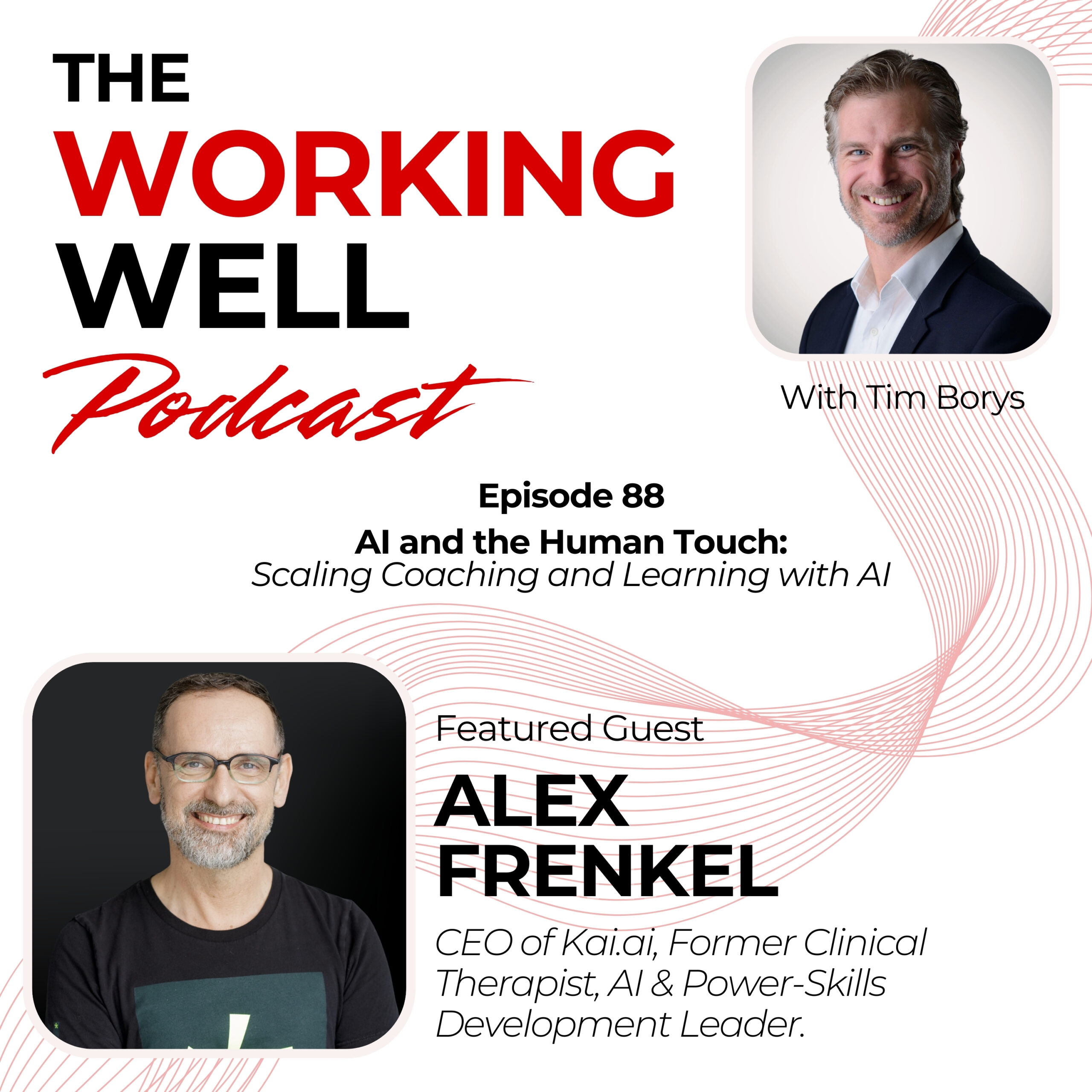
In this episode of the Working Well Podcast, Tim Borys welcomes Alex to explore the rapidly evolving role of artificial intelligence in coaching, therapy, and workplace learning.
Alex shares how his career began in clinical psychology, where he worked as a therapist and counselor before transitioning into the technology sector. This journey led him to build AI-driven solutions designed to support professionals rather than replace them. His current work focuses on combining technology with human expertise to create positive impact at scale.
The conversation dives into the explosion of AI tools following the mainstream rise of large language models. While many people believe AI may replace human professionals, Alex argues that the opposite is true in fields like therapy, coaching, and leadership development. These areas require human connection, empathy, and communication qualities AI cannot replicate.
Instead, AI works best as a force multiplier. By assisting professionals with tasks that are difficult to scale such as continuous check-ins, learning reinforcement, and real-time feedback AI enables coaches, therapists, and leaders to support far more people effectively.
They also discuss the risks of misusing large language models, including hallucinated advice and unsafe applications in emotionally sensitive contexts. Alex emphasizes that AI should be carefully designed to support professionals rather than replace them.
Ultimately, the conversation highlights a powerful idea: the future of AI in human development isn’t about automation replacing people it’s about technology amplifying human expertise.
🔑 Key Takeaways
- AI is not replacing therapists, coaches, or HR professionals anytime soon
- Human communication and connection remain essential in coaching and therapy
- AI can act as a force multiplier by supporting professionals between sessions
- Continuous check-ins and learning reinforcement are powerful AI applications
- Large language models can sometimes hallucinate and provide incorrect advice
- AI works best when designed to empower professionals rather than replace them
- Real-time learning and feedback may transform workplace development
Episode Links & Resources
Connect with Alex Frenkel here:
Website: https://kai.ai
LinkedIn: https://www.linkedin.com/in/thefrenkel
Podcast Highlights
Please note: This highlight is generated by a computer and may contain errors.
Introduction: AI Enters the Mainstream
The episode begins with a discussion about how artificial intelligence has suddenly become a dominant topic across industries. While AI has existed for decades, the rise of large language models has pushed it into the public spotlight and sparked widespread interest.
This shift has raised many questions about how AI will influence coaching, therapy, and workplace development.
From Therapy to Technology
Alex explains that his career started in clinical psychology, where he worked as a therapist and counselor for several years. Over time, he became fascinated by the potential of technology to scale human impact.
This led him to transition into the technology world and eventually work on AI-driven solutions designed to support human development at scale.
What AI Cannot Replace
Despite the rapid growth of AI tools, Alex is clear about one thing: AI cannot replace the human element in fields like therapy, coaching, and leadership development.
These professions depend heavily on human communication, trust, empathy, and emotional connection. While AI can support these processes, it cannot replicate the relational depth required in these interactions.
AI as a Force Multiplier
Instead of replacing professionals, AI can make them more effective.
For example, therapists may only be able to see a limited number of clients each week. AI can support these relationships by providing additional touchpoints between sessions, such as check-ins, reminders, or guided exercises.
This creates a scalable way to extend support beyond traditional one-on-one interactions.
The Future of Learning and Development
AI also has the potential to reshape how learning happens in the workplace.
Instead of relying solely on courses, lectures, or webinars, professionals may increasingly receive real-time feedback and guidance during their daily work.
For example, after leaving a meeting, someone could immediately reflect on the conversation and receive coaching or learning insights through AI.
This kind of immediate learning support could significantly accelerate development.
Risks and Misuse of AI
The conversation also highlights important risks.
Large language models can sometimes generate incorrect information or “hallucinate,” which can lead to misleading or harmful advice if used improperly.
Because of this, AI systems must be designed responsibly, especially when used in emotionally sensitive fields like therapy or coaching.
Closing Reflection
The episode concludes with an important insight: the most powerful use of AI is not replacing human professionals, but amplifying their ability to help others.
When used thoughtfully, AI can extend human expertise, increase access to support, and improve learning at scale.