Podcast Summary
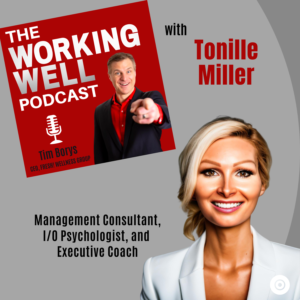
Why are people and performance suffering so much in companies today? How can companies operationalize business strategy and employee experience in a way that helps people and companies Flourish? What is the role of leadership in making sure these changes happen? Those are just a few of the important questions we discuss today with special guest organizational psychologist Tonille Miller.
Welcome to the Working Well Podcast, the show that explores the rapidly changing landscape of work and wellbeing. Each episode, We dive into the hottest topics in leadership, employee wellbeing, and the future of work! I’m your host Tim Borys.
Episode Links & Resources
Connect with Tonille here:
LinkedIn: https://www.linkedin.com/in/tonillemiller/
Speaking/Coaching Website: https://www.tonillemiller.com/
Company Website: EXT – Experience and Transformation (https://www.experienceandtransformation.com/)
Tonille’s Book (The Flourishing Effect): https://tinyurl.com/theflourishingeffect
Podcast Transcript
Please note: This transcript is generated by computer and may contain errors
Introduction and Catching Up
Tonille, welcome to the show. It’s great to have you. It’s been what, two weeks since we chatted and yeah. So great to see you again. You too, Tim. Thanks for having me today. Yeah.
Discussing Current Trends and Changes in the Workplace
And before we jump in how things been going what do you see new on the horizon? Yeah, things are going well. I think that, every day we’re seeing new things and we’re seeing old things come back over and over, like the return to office demands and things like that one just won’t die.
So that’s keep coming back, even though it’s not new, but it’s just fascinating to see that one, just not go away. But I’m just, I’m seeing a lot lately with AI and, just different ways of, hiring folks and just different technologies. And I don’t know, it’s really an exciting time for us.
I think in this space, I would agree. Yeah. There’s a lot of change happening and, one of your backgrounds is change management. So that’s you’re probably running quite quite busy these days with work. [00:01:00] Absolutely. Now, if we.
Exploring the Impact of AI and Return to Office
Take into your experience with the A. I. And returned to office.
What do you see is the biggest opportunity available for companies today to capitalize on? There’s let’s see. There’s so many. I think when it comes to A. I. This isn’t rocket science that I’m saying right now, but I just think that people a lot of folks don’t know how to leverage it as well as they could.
And they’re thinking, Oh, it’s farther off in the future than it really is. And I think that’s maybe not a good thing. And so I think that organizations that are really digging in and all levels, everyone from the individual contributor level, all the way up to the CEO, everyone’s really trying to upscale themselves and understand what it can do for them and how it can actually, it’s not something to be afraid of.
It’s actually something to take all those redundant. Boring, less humane tasks off our plates so that we can do that more higher value, more strategic, more meaningful work. So I think that right now is the biggest thing that I think we need to be capitalizing more on. I agree on that. What [00:02:00] companies are you seeing or you don’t have to mention specific company names, but what examples are you seeing of companies using it well and doing it well?
The Role of AI in Automating Tasks
Yeah, I won’t list names just for various reasons, but I, several clients are doing a lot in the space of, again, automating a lot of the copywriting, right? Marketing a lot of the marketing department not saying that’s good or bad, but it is what it is. A lot of the legal work that needs to be done.
A lot of that’s being automated and they’re doing that. I’ve also seen a lot of interesting things. If you look at AI and return to office together, right? You think about both those together. I’ve seen a lot of companies. Some great ones, actually, that are have developed these really great apps so that it actually makes that less of a hurdle.
So it’s you don’t go into the office and then we’re all on zoom calls with other people. There’s lots of great apps that have come out in the last couple of years that really help orchestrate that. And I think they call it structured hybrids are really understanding who’s going to be in when.
Connecting with them, having the calendar all synced up and everything else so that it really isn’t this hurdle to get over. It’s really more. So it’s actually better than working from home some days or being [00:03:00] demanded to go to the office. It’s actually that nice hybrid in between. So those are some of the things I’ve seen most recently, but I think those are really interesting.
The Challenges of Return to Office
Yeah we’re seeing that in Calgary some companies are mandating back to the office. There was a large company that is now officially five days a week back in the office. And what are you working with that company directly or you just read about it? No, I’ve got some friends and colleagues that, that are at that company now and the pushback is so big.
Yeah, how are they reacting to it? Meaning like the people that, you know, and maybe their colleagues and things like that, or is there talk? There isn’t a lot of organizations where once that demand is put in place. Oh, we’re all looking for jobs in other places, or are they going to stick it out?
Or what are they thinking? Yeah, there are many of them that are looking for other jobs and they’ll stick with it until they find something. But as soon as something comes up, it’s at the same level and they have the [00:04:00] flexibility. Yeah, they’re gone. Absolutely. This is just, we can talk all the podcast just about this topic really.
This just doesn’t die. But it’s just, it’s interesting because I think, depending on the different companies and the different leaders, the ones that are demanding it, I know. Several of them have different reasons, and we don’t necessarily need to go into all the different reasons. I think we know most of them, but I find it fascinating that they say, oh when the labor market is less tight, or the economy, or there’s a potential recession on the horizon, they feel like, oh, good.
This is a time for us to really make these demands. And it’s get over it. It’s not about the back and forth. Tight labor market, and then the employees had more say, or, the opposite. It’s not bad. It’s literally a problem that everybody should be addressing together in ways that work best for employees and leaders and the organization versus treating it more like a like a baseball game or something.
Yeah. It’s so adversarial. It’s like us against them. Hey, we’re trying to make this collaborate on what the best solution is for the people and the company. [00:05:00] Exactly. And the sad thing is it wasn’t ever that before leaders, the ones who do this made it that way. Because it’s not like employees just decided, oh we’re going to stick it to the leaders and never come back.
It’s like the leaders are the ones that I’m seeing, not all of them, but some of them that are demanding this. They’re the ones that are making that adversarial game where the employees aren’t. It’s not a game. It’s Hey, we proved that this worked really well for a couple of years. You have the proof you were profitable.
We made you, more money during that time and we did it fine. And now you’re acting like, it didn’t happen. And so it’s just like a weird psychological disconnect. I actually talk about this in my book and it’s just it’s just a lot of psychology happening there. It’s just fascinating.
And you have this we’ll talk a bit more about your book in a bit because it definitely. Comes into play what we’re talking about here, but you have this operational background as well as the people side and the business strategy consulting.
The Importance of Employee Experience in Business Strategy
How do you mix those together in the work you’re doing with clients?
Yeah, and this is [00:06:00] something that I guess, for me, I think I just I’ve taken it for granted because I’ve been doing this work for so long and all these different capacities and I have a very systematic view. I see all the parts of it because I have done it from different vantage points. And so I haven’t seen a lot of people talking about it this way, but what I’ve come to the conclusion of is.
Operationalizing Business Strategy Through People
What we really want to be doing is operationalizing our business strategy through our people, right? Because a lot of times they think about, oh, HR is over here. That’s this 1 off thing. Our people’s they don’t see it as connected. A lot of people in the organization. And so what I try to coach leaders on and say, no, it’s actually, you are driving your business strategy.
If you do it right, you actually do drive that through your people. And the way that happens is through how you design your employee experience. And your culture and then the organizational systems that deliver it. So stop me anywhere along the way. But the way that I see that happening is if you first think about, typically 1 of the items on the strategy list business strategy is, customer experience, right?
We always want to be customer centric. We want to have a great customer experience. I always ask leaders to start with that. Maybe if they haven’t thought of something else and [00:07:00] just ask yourself what type of experience you need to create for your employees so that they can then deliver that kind of great customer experience, because what happens a lot of the time is we focus so much on the customer experience.
We’re not realizing or not focused on the importance of we need employees are delivering that to your customers. So they need to actually have that great experience as well. For example, it’s really hard. For your brand to deliver like a cutting edge, seamless, intuitive customer experience. If internally there’s all kinds of clunky and wonky processes, it’s bureaucratic, there’s friction for employees, like that kind of stuff doesn’t make them better able to deliver a good customer experience.
And so it’s like thinking like that is one lever that I show leaders to pull. So getting that plus to employee experience too. Deliver the customer experience you want.
The Role of Culture in Delivering Business Strategy
And then the big 1 that actually is all encompassing is really the culture. And this is again, a topic that we could talk about just this alone, probably forever.
But what I see is. First of all, the culture is part of the employee experience, right? So it’s part of that the [00:08:00] whole experience that employees have. And what I tell leaders is that when they leverage it very deliberately, and it’s strategically leveraged, it actually delivers your strategy because think about it.
It’s almost a self driving car. If it’s programmed right, the algorithms programmed right, and it’s, deliberate and you’re always updating it and staying vigilant about it and that sort of thing, it’s going to automatically deliver you to your location. And that’s exactly how I talk about culture, so we can talk more in detail if you want me to about what that looks like but that’s really how I see ways that leaders can operationalize their strategy through their people.
Yeah, I love that and it talks to. A lot of the challenges that businesses face, because a lot of senior business leaders are focused on the operations, the process, the delivering results for the bottom line and people often get lost in that. So it’s not either or it’s both being when you do both, you deliver results for the business and the people, [00:09:00] because if the people are performing well.
And that’s really what this podcast is all about is how do we connect business performance and people performance. And in the past, those have been seen as separate. Yeah, exactly. I love that. I’m so glad. And that’s one of the reasons I was so excited to join you today is because that’s exactly how I think about it as well.
It’s not people or the business strategy. If the people is like the front end of it, and that will actually be like the flywheel to deliver the strategy. And so one of the ways that I start with leaders in this culture space about this is We talk about so if you think about what needs to actually change or evolve in the organization for it to happen, right?
So you think about if we want to digitally transform our technology, or we need a, culture of innovation to deliver on our business strategy, or if we need to be more customer centric. That would mean things like breaking down silos and, improving collaboration. So it’s basically like, how I position it is it’s a reverse engineering it.
So it’s you reverse engineer it by building your culture to deliver through the environment and [00:10:00] behaviors and mindsets. That’s how it delivers your strategy. And so it’s like you think about, okay, so who’s impacted by it? What will they need to do differently? What’s in it for them? Like all these kinds of questions that we ask as far as like the employees and the things we need to think about when we’re building our culture and we’re evolving our culture if we already have one.
And thinking through what do they need to be successful? In doing the things we need them to do to drive that strategy, right? And so I also recommend that we’re doing co creating and things like that along the way, but it’s very much, I see it as an input. I see it like investing in the employees and like the experience they have and the culture and the environment and their wellbeing investing in that drives the business strategy is how I position it.
Love that. Yeah.
Challenges in Operationalizing Culture
And more companies thought that way. People will be happier, more engaged and goes to the next question is what are some of the most common challenges companies face when trying to operationalize their culture? Yeah, there’s plenty. I think I think 1 of the [00:11:00] biggest ones is a lot of people don’t really understand what culture is.
They, they’re like, Oh, we know it’s important. We know we see the bottom line. There’s tons of data showing the metrics on impact of a toxic culture or otherwise. But they just don’t really understand it. And so I always share them. Like it’s literally the most strategic lever.
You’re either not pulling or not pulling in the right way. And that’s how I always feel like, if your business strategy isn’t being achieved, it’s probably a culture issue. Cause I just feel culture really makes or breaks the organization in terms of, as we know. Productivity, profitability, engagement innovation, customer satisfaction, burnout, like all those things that we’re talking about.
But it’s interesting too, because I saw a study recently from MIT and they were in a study. It said that like 90, 92 percent of leaders, they know those things, right? They understand the importance of culture and its impact on the performance in the organization, but only 16, 1, 6%. Are doing anything about it because I think it’s too complicated or time consuming.
And so I always go in there and simplify culture to them and help them understand that it’s literally what you [00:12:00] need to be doing is being very deliberate. As I said, reverse engineering, what we need to accomplish in the business, working backwards, as far as what environments we need to be creating through mindsets, behaviors, experiences for people to deliver that.
And then that’s how you build your culture deliberately, right? So whether that’s the values that you focus on, there’s all kinds of levers we can talk about how you. Build and demonstrate evolve that culture, but essentially you’re reverse engineering it. And then the biggest thing, too, I think is that a lot of leaders and just people in general, not just peers, but they don’t realize that you need to be very deliberate with it.
Like I said, you need to be very vigilant with it because literally your culture changes moment to moment. You hire new people. Your cultures change. You let people go. Your cultures change. You have new processes, new technology, whatever your cultures change. And so you have to always be monitoring it.
The Need for a Chief Culture Officer
And so I almost wish that there was like a chief C level, like chief culture officer, but not just for, touchy feely kind of things that we think our culture, but really metrics driven how we’re measuring our [00:13:00] culture every day. How we’re adjusting it, how we’re iterating on it, how we’re building that into organizational systems, how we’re, incenting people and disincenting people when they’re living the values and the culture by, and not things like that.
So I think we need to get a lot more operational about it. Yeah.
The Disconnect Between HR and Business Strategy
And you speak to something I see all the time is the, usually the C suite thinks of HR as this fluffy thing, or it’s a administrative function for payroll and benefits. Compliance and they’re not seeing that as a strategic lever and one of the roles that I always.
Companies to hire a chief well being officer and being and you specifically use well being instead of wellness, because wellness is seen as HR and tactics as well. Being is about performance and thriving. And in order to do that, you have to have culture, but you also have to have metrics. You have to have [00:14:00] strategy.
Are we implementing that from the C suite down? And yeah, like whether you call it chief well being officer, chief culture officer, chief. People performance officer, something like that. Companies that get the CHRO or the CPO role and they’ve elevated HR to the C suite. I think that’s a great start.
Often I’ve seen people in that position are some of them are not HR related at all. And so they’re not seeing the people picture and the HR people that are elevated to that role tend to still come from the benefits and payroll side. And they’re, they are learning to think more strategically at C suite, but it’s still not happening as often as you want to see it and particularly.
about that operationalizing performance. I love that. I’m just gonna take a note here. First of all, I agree a hundred percent. And I think that’s where we get [00:15:00] that when it’s successful, I think that’s what the language we need to be using is performance because performance in it is like, Hey, It includes well being.
It includes the metrics. It includes all that stuff. So it’s not just soft stuff, but it’s also the hard stuff and we are measuring it. And I think there’s some of the beauty is there is a ton of data out there of how the right culture or the right experience and some of these things that are typically thought of as more soft.
There’s lots of data that shows they’re not soft at all. And there’s. Direct correlations to the bottom line and things like that. But to your point, I think it’s almost like we need to work on the deliverer. So maybe we have a that is really that benefits compliance kind of function and that’s fine.
But then we need somebody else as well. I think that isn’t an HR C level person, but they are focused on the performance and the culture. We should invent that basically is what I’m thinking. Yeah, there are very small number of companies out there that have. Elevated that being performance to the C suite.
Yeah. It’s so rare right now. [00:16:00] Jen Fisher at Deloitte in the U. S. I was just going to bring her up. Yes. Yeah. And she, and that was 2012 when she got into that role. And now they use it too, because it was chief wellbeing officer. Now, I believe they call it human sustainability officer, which is so cool.
Yes, exactly. And realistically, whatever name you choose is almost irrelevant. As long as the mindset and the purpose towards that role is. To, yeah, sustainability of performance of people. And, there’s Dr. Steven McGregor wrote the book sustaining executive performance, and I love that. It’s a great book.
And he has the chief wellbeing officer podcast, and he does all lots of that work, but his thing is and where I came from as well as the athletic side, when as an elite athlete or coaching elite athletes. You [00:17:00] can’t expect people to perform at a high level over the long term if the entire environment isn’t right.
You have to have the right culture on the team, you have to have the right support systems, the right structure and operationalizing the, their days, basically. They put a lot of effort and focus and metrics into being able to perform well over the long term. So why don’t businesses do that for their so true?
So I love that you brought that up.
The Importance of Performance Reviews
And that is your background because I bring that up too. And it’s if you think of any elite athlete in any realm, they’re constantly coached, constantly getting feedback, constantly pivoting, which is totally different than the way that we do our performance reviews, for example.
And to your point, it’s not just about them individually. It’s the environment, which makes a huge difference, right? their home environment. They’re taking care of their body. If you think about it’s about their body as well as their brain or their performance in more intellectual capabilities.
So I think we need to get to a point where we are really using those metaphors more in the [00:18:00] workplace. It’s funny you brought up performance reviews. Imagine if a coach had a once a year performance review with their players. No. Yeah. By the way, remember 10 months ago that thing you did, you probably could have done it better in this way.
And once a year you get this feedback. It’s come on it’s absolutely useless. And the fact that companies are still doing these formal annual reviews with not much else in between is speaks volumes. It absolutely does. And then they wonder why people aren’t performing at the levels they want them to or why people are leaving or what, there’s all kinds of, there’s all kinds of things that happen with that too.
And it’s like at that point in time, because so much time has passed, not only can I not really take action on it, it’s not relevant. You don’t remember half of it. And then there’s also, if you think about the psychological dynamic, there’s resentment from both sides. Building up to that from probably the manager because they’re resenting the person isn’t performing that they want him to.
And then once that person gets that feedback, then tons of resentment comes out. So it’s Hey, I can’t do anything about it now. I can’t [00:19:00] learn from it. So it’s just really not helping anybody. Or they feel blindsided. I had no idea. I thought I was doing a great job. And now a year later, you tell me I’m not.
Exactly. Yeah, I just, it feels almost like you’re lying, right? The relationship is not authentic in that moment. Yeah.
Change Management Strategies for Leaders
And change management is also something you that’s in your wheelhouse. How, what are your strategies and I guess tips for helping leaders? Particularly manage change throughout their teams.
I guess globally, the organization. Yeah there’s a lot of work here. I think a lot of times what I’ve learned is that a lot of leaders they want their people to change, but they don’t realize that means they have to change and they have to do something too. And so that’s 1 of the biggest gaps that I have to educate them on is hey, you want your people to adopt this technology platform where you want them to do this over here.
You need to lead that as a leader and you need to be authentic about it. So we have very deep conversations in the very beginning of [00:20:00] once we understand what the change is and who’s going to be impacted, how they’re going to be impacted, what they need to do differently. And all those things, there’s the discussion then of what are you as a leader willing to do?
As far as leading this right, because a lot of them just think it’s sending an email. That’s all it is. People comply. I’m like, no, that didn’t work great back in the day. And it definitely doesn’t work. Today with our very co creative Gen Z and millennial colleagues. That’s not how they work. And it didn’t really work.
Anyways, as I mentioned, so I have a conversation with them understanding Yeah, From a leadership perspective, how can you lead this? How can you message this? How can you be the one rewarding and recognizing people that are doing the right behaviors and the things that you want to see? How can we?
Have you lead and maybe show examples of yourself doing that change and really making things tangible sometimes with symbols if we can that are maybe part of the culture if we can. So it really depends on their organization and their culture and what the change is. But I really try to educate them on the front end that this needs to be led by you and your team for everyone else to come along on the [00:21:00] journey.
The Role of Leadership in Employee Experience
I’m glad you brought up the leadership side because yeah, that’s a key barrier that I see and a disconnect is. Change wants to happen, but it’s led by leaders. You talked about employee experience at the beginning and how do you see leadership development really contributing to that employee experience?
Or I guess what needs to happen. To for in leadership development for employee experience to really change. Yeah. Let’s see here.
Understanding the Employee Journey
It depends on well, you think here because the employee experience is really every moment, right? So it’s everything from before someone even works for your organization.
They are looking at glass door at your company and they’re thinking about your brand and maybe asking people what they think about working there. It starts that. And then it moves all the way into any, every aspect of hiring, interviewing, onboarding, any development during the time of their whole employee [00:22:00] journey.
And it still goes to once they’re off boarded and they’re still in your ecosystem. How did you treat them? Is there an alumni network? Are you still engaged with them? It’s that whole process. So if you think about it that way.
The Importance of Upskilling Managers
The manager or the leadership role comes in there where a lot of it, I think, is just really upskilling managers on being better managers.
And again, this is something we can also talk about forever. But I just feel like we are at a systematic level in our most organizations today, because of the way they’re still set up on these linear career paths from 100 years ago, people are promoted because they were a great individual contributor, or they were there for a long time.
And then they’re promoted, but they’re usually not given training, or if they are, it’s. Minimal or it’s years down the road often. And then they’re also not really asked if they even want to leave people, but that’s the only way to progress and make more money and get promoted and titles and things like that.
It’s because the model. So I say all that because that already shoots us in the foot from having great from a perspective of expecting to have great managers. But I think that the [00:23:00] manager. There’s a lot of things they can do, but it’s like the organization really needs to be deliberate about it.
And it’s great. If the individual has enough ability to go out and upscale themselves and get a coach and try to be a better manager on their own. But I really think the environment is key.
The Impact of Organizational Culture on Employee Experience
And for example, that’s where the culture comes in again. I could be a manager. Maybe I’m trying to just have the most amazing team.
I’m upscaling. I’m getting a coach. I’m doing all kinds. I’m doing all the right things to be a great manager. But let’s say the culture is terrible or a senior leadership is not walking the talk, or they’re doing all kinds of things wrong. That makes it really difficult.
The Challenges Faced by Managers in the Current Climate
Like for example, not to bring up the RTO thing again, but this is a good example of it.
Managers are really in a squeeze right now, right? Because a lot of these senior leaders are demanding people come back saying managers, you have to enforce it. And then their people are pushing back on the managers. And so the managers are really in a tough spot for a variety of reasons right now. But those are just some of the things that come to mind as far as how the manager plays into that employee experience.
Yeah. And you brought up a good point about the.
The Role of Executive Coaching in Leadership Development
People that are proactive and growth mindset are going to want to [00:24:00] improve their own skills as an executive coach. I see people coming to me that say, Hey, I’m leading a team now. I don’t feel I have the support for my organization. So I’m going to hire you as a coach to help me through this process.
And I think that’s why we see bright spots within organizations where certain leaders have taken upon themselves to do it. And their team is thriving, but you look at another leader in the same or same division, and it’s a toxic environment for there. When people move in and out of those teams, it’s dramatic.
My partner is she leads teams in a technology within a larger, pretty, or stayed, traditional organization. And she leads the technology thing teams within that. And people moving in and out. That are coming from other parts of the organization like, oh, your team is so different.
We’ve never seen [00:25:00] anything like this and it’s not uncommon to see that in companies. I think there’s what you said, operationalizing the people development from the leadership standpoint, but also how that trickles down to everyone throughout the organization and the well being sustainability performance, whatever we want to call it at that point starts to improve globally throughout that.
I guess we can say globally through the world as well. But within that company particular. anD that’s why you hit on a great example here. That’s why it’s important to have that sustainability human performance officer at the sea level because in not. Housed in HR over here because they need to be able to come and find these bright spots.
Let’s say that for example let’s say Jen, for example, let’s say she sees that there’s a couple of leaders in different lines of service or different business units that are really those great leaders, those great managers. [00:26:00] She, if that’s her job, she’s got to be on the lookout for that kind of stuff.
And I don’t know if she is, but I’m assuming I’m putting words in her mouth here, but I’m assuming that could be a function where people either come to her and tell her that, and where she sees that in the data for the performance reviews and promotions and how people are following different leaders.
And she’s, once she learns that, then it’s okay, let’s replicate these bright spots. What are they doing? Let’s go in there and get curious and find What they’re doing well and really build that into some of the different behaviors of the culture and maybe expectations of managers and ways that we train managers and that sort of thing.
And then on the flip side, when we’re hearing about bad managers who maybe through exit interviews or other forms of data, we’re learning that people were leaving them in droves and things like that. Let’s find out what they were doing wrong and then not let that be the case. And so I think that’s a really interesting way to bring data into it as well, because she’d also have that bird’s eye view.
That can see across lines of business and service and things like that. Yeah, that’s and that’s an excellent point because right now, in most organizations. Learning and development will do [00:27:00] some of that. HR will do some of that from the performance review side, but they don’t often talk to each other.
There’s no one, there’s no one higher up in the organization that has that bird’s eye view that is being able to connect those people. Yeah, and that’s a big gap, right? You and I are just talking about it right now. I’m assuming people that are going to watch this and listen to this and say, Oh yeah, that totally is a gap, right?
Because that’s the other thing too that I’ve noticed, whether it’s doing change management work or culture work or whatever it might be is. Everything is seen as a disconnected entity in the company. Oh, I’m in marketing. I don’t need to worry about HR. HR is over here. This is over there.
Everything is in the system. Everything is in the environment. Everything impacts everything. And so that’s why we need somebody at that very high level to be able to see how all those things are impacting each other, the systems, the rewards, all that stuff.
So what are, in the organizations you’ve worked with? What are some of the most innovative ways you’re seeing companies do that? Maybe not at that [00:28:00] top level, but at least from an engagement. Employee experience standpoint versus the most innovative. Let’s see here.
The Role of Technology in Employee Experience
It’s interesting because it changes with things like different trends, like technology, for example, I’ll just rattle a couple of things off that occur to me.
I think bringing, making sure number 1, that the technology is up to date, because that’s another gap too. And it’s part of the employee experience. It’s a big part of it. I forget the number, but there was a study done a little bit ago, like a year ago, and I think it was like. 35 or 40 percent some significant number of Gen Z employees said they would leave their company if they had terrible technology.
And actually, a lot of them do, especially the big enterprise companies, they’re still dealing. A lot of them are still dealing with the old clunky enterprise technology. And that’s stepping back in time. If you’re a Gen Z or a millennial person, because you’re used to Netflix and Spotify and Amazon, everything being hyper personalized, user friendly, easy to use catering to you in your day to [00:29:00] day life.
And then you have to go back in time to go to work. So I think one of the biggest things is technology and just, staying, like I said, stay on top of my AI, find ways to make people’s jobs easier and less have less friction using AI and having data that speaks to each other instead of in silos.
I think that’s a big one. I think the other part is different psychological principles. So for example, When we’re rolling out a change program, a new change happening or a new culture or any anything happening at a company. We need to bring in people at all levels of the organization to co create it with us as early as possible.
That’s a more of an innovative mindset. Not necessarily an innovative technology, but it’s a mindset and it’s really part of design thinking and just having more agile ways of working. That’s really important.
The Misconceptions about Employee Experience
I think As you can tell, I’m not rattling off things like a foosball table or Taco Tuesday, because that is not the employee experience.
That is not culture in a better way. Anyone thinks that’s not it. Those are like band aid cosmetic things, but that’s not actually moving the needle in any [00:30:00] significant way. So I’m just going to pause there and see if that’s the road that you wanted me to go down. Or are there other areas you want me to dive into?
I love that. 2 things you said is 1st that. The foosball tables and the taco Tuesdays. It’s so much of that. We see that on the wellness side too. It’s oh, we’re going to offer this. We’re going to offer that. We’ve got a massage therapist coming in. We’ve got a gym. We’ve got all these stressing you out so much that it doesn’t matter how much, cosmetic stuff we did because you’re so stressed out that you can’t even sleep at night.
Yeah. And, the yoga class at lunch, That can be a great tool in the toolbox, but if people are getting book meetings over lunch and they can’t attend the yoga class and they’re rushing around to try and get to it because their leader is not supporting them or the organizational culture doesn’t do that, then what’s the point?
And so when that’s why I got out of wellness and started doing the consulting, the coaching, because I was like, we’re offering all these programs that the people that take them love. But it’s not [00:31:00] making a difference in the organization. And I also, you said something else that stuck out. Now, I’m drawing a mind blank on it.
It was, or co creation. It’ll come back to me. It’s okay. No worries. And actually I love that you brought up the wellness and the well being point because I actually started my career and this is how I found this kind of work. I started at a company called StayWell Health Management, and I was there for a couple years and we did that.
We did the research and I got health risk assessments of employee population so of course understanding the top causes of death the top causes of the health care costs which are insane in the U. S. And so we did all that research, but then we also created programs, being programs that you’re talking about.
I know very well what you’re talking about. And what I learned there, and that’s what kind of opened my career up to all the work I do now is that you can have the best program, the best one off, whatever, like you said, the best massage therapist, the best snacks, farmers [00:32:00] market in the backyard, whatever it might be.
But if you’re not thinking about it holistically, including all the cultural levers you talked about if you can’t take a walk at lunch because you’re triple booked at the CEO frowns upon people going out for that walk at lunch, whatever that case may be all those levers in the organization. Will make or break any program, whether it’s well being technology, business strategy, whatever it is, those levers are all going to make or break it.
And so that’s why I always advise leaders to think about this very holistically. Like you said, it’s operationalizing the strategy, which means you’re thinking about all these levers in the system, and you’re using them strategically to get the results that you want.
Yeah, I agree. We’re speaking the same language for sure.
The Future of Work: Return to Office or Remote Work?
Now, return to office has come up a few times, and I take it you’re a big fan. I just, I feel like I’m reading the sports pages every day when I look at the news at the stories about it. Cause like I said, it’s one side or the other, and it’s very, everyone’s very clear on where they [00:33:00] stand, but it’s just, there’s no right answer, which is really interesting.
So we’re, people keep talking about the impact of COVID and yeah, we’re three and a bit years at three and a half years out now from the start of it. What do you see the next five years looking like in terms of. Where that evolves. Yeah. One of the things that I have realized over the years as well, and it’s probably why I speak so strongly on this is that I’ve actually been remote hybrid distributed for a decade.
I’ve been in a consult, as you probably have in many ways as well, right? You’ll travel to a client site if you need to, you have a meeting here and there. Maybe, when I was at PwC, for example, I’d go to the office if I had a connection or a meeting or whatever, but like for the most part, your clients are always across the world and across the country.
So unless there’s a real significant reason to get together, most of the work is always done, remotely or whatever anyways. And so I’ve gotten very comfortable. It’s great. I think it’s so wonderful and I’ve seen all the benefits of it, but what I’ve realized is that is not the case for everybody.
Obviously, this was a new thing for a lot [00:34:00] of people and they aren’t comfortable with it. But what I would say to answer your question, I think based on all the data that I’m seeing as far as the real estate trends, and now that the leases are starting to come up over and over up these buildings that have been sitting nearly empty, and people are downsizing their space.
It’s not like it’s going away. Office isn’t going away. We know this. But I do think that we’re very much moving more into that Distributed flexible, I would call it flexible models. So obviously some organizations are doing this well, where it’s hey, we have offices. If you want to come in, the space is smaller than it was and they save some money on that and they save carbon footprint, but essentially it’s not a demand.
And what they’re finding is, Gen Z specifically, they want to come to the office. They’ve never been in the office before the pandemic, they weren’t working. And people do want to come in and that’s the beauty of it, but they don’t want to be told what to do, like they are little children.
And so that’s where, I’ve been doing a lot of work with coaching leaders around. First of all that, right? You don’t have to be in the office. There’s ways to do it, all kinds of great ways and practices. But then also, if they want to do it well, if they do want to get people [00:35:00] back, do not make demands is what I tell all of them.
There’s a lot of ways to make it more of a magnet, not mandate strategy. And I think the companies that are doing really well are employing things like that. They’re employing behavioral economics. They’re doing things, like I said, with those apps we were talking about. So you can actually do structured hybrid and know who’s coming in when, so you can plan your day around it.
Yeah. There’s all kinds of wonderful tools that are emerging now, and I think that I recommend to all leaders, really get on board with that, right? Just stop making the demands. If you do one thing, leaders, just don’t make the demands because that’s not helping you. And there’s a lot of really interesting, creative ways we can get, get to get to a, I think, more of a common future together if we do it together.
Yeah, I agree. And short of roles that need to be in person, like if you’re I was even, I was going to say if you’re a surgeon, but now you can do robotic surgery. Yeah, I’ve been seeing that. Yeah. I’m sorry, BMW and a few other organizations have been using digital twins to build things. So it’s like you really don’t even have to be there [00:36:00] for some of these physical roles anymore, which is so cool.
And there are people will choose. I know I love to go into the office some days and you brought up the great point is that consultants and, as a business owner, I in and out all the time. I’ve been at least. 15 years, I’ve had virtual staff overseas use freelancers all the time. I’ve had clients all over the country, all over the world.
It’s not new, but as you said, most people haven’t done it before. And so it is new for the majority of the working world. And we know there’s no technological barriers for it. We know that most of the brain jobs or most corporate roles can be done from anywhere. And they have been done. Think about it.
Like I always laugh at these leader and I’m like, I’ll be in coaching conversation. I’ll be [00:37:00] like, so let me get this right. So you’re not sure if your people are working yet before the pandemic, they would take work home, take their laptops home, nighttimes, weekends, a lot of times they’re checking email and doing things when they’re on vacation.
So it was okay for them to do it then, but they’re not working now. Like, how does that connect? I just don’t understand that. Yeah, that, that whole trust communication, that’s crazy in a long way to that. But just my logical brain goes there again, we could talk all day about this, but there’s a lot of layers to this, right?
So to your point, the technology isn’t the problem. We’ve had it for a long time. People have been doing this for a long time in some level, but I think that ego slash the leader, not feeling like they have a role. I’ve heard that from a lot of leaders that I’ve been coaching where they’re like, Hey, between you and I.
If I don’t have people, if I can’t see people out there, not scurrying around, but out there looking busy. I feel like I’m not important because they don’t need me basically. And I’m like that’s not that’s your ego. That’s not a reason to demand people uproot their lives, move [00:38:00] back to a big city that they moved away from during the pandemic or all the other different things that are happening.
And the other part too. Is that I always in a lot of my writing and speaking, I’m trying to bring out the other points of view that I think leaders aren’t seeing, because it’s not all leaders, but some leaders like they’re very much in their own echo chamber and in the average CEO is usually an older white male, right?
Nothing wrong with that. But the point is your employee population, their lived experiences, what they look like, what their lifestyle is, how many people they have to care for at home, all the things. Is probably drastically different than the majority of CEOs. And so when the CEOs are making these decisions.
I don’t think they’re, I think they’re taking for granted that they’re like, Oh, I’m fine. We can go back to the office. It’s but yeah, but you’re, but the pandemic showed us that all these women, all these folks from minority backgrounds, all these people with caregiving duties, the code switching, the, all this stuff that was going on, the microaggressions, all that stuff that was really unearthed during the pandemic, it was always happening, but it wasn’t brought to bear the way it has been now.
So that’s where I get upset about this. Cause I’m like, leaders who [00:39:00] are making these demands now are basically like gaslighting their people because they’re like, oh, we realize that you’re getting, you’re having to code switch in the office. We realize there’s microaggressions happening.
We realize all this stuff that our employees are going through. We now know it. It’s now in the open and we’re saying, we don’t care. We’re saying you still need to come to the office. And that I think is, that’s a real juicy topic. I don’t know. So before we wrap up, I wanted to, I know a lot of the stuff we talked about is.
The Flourishing Effect: A New Approach to Employee Experience
Touches on, or is touched on in your book, The Flourishing Effect. Yeah. Give me a quick overview of the book and the listeners and over, a quick overview of the book. Yeah, it’s called the flourishing effect. It launched a little bit less than a month ago. I’ve had some really great feedback.
It’s just been so much fun and really what it is I just realized again everything that we’re talking about today. I just over the years and all the different roles that I’ve had and industries and organizations. Again, I have that very systematic view and so I keep seeing these blind [00:40:00] spots over and over that’s tripping leaders and or their organization up.
I’ve also seen what works really well and some of these really innovative organizations and so I thought, you know what? so much. There’s never been a better time to address all these issues that everybody’s talking about than now. So I, it took me about a year to write it and I’m really excited about it.
Fantastic and where can people find it? It’s on Amazon. It’s on Barnes and Noble. And I think anywhere you buy books, it should be available. Excellent. And where can people find you? LinkedIn? Where else? Your website? LinkedIn for sure. I love connecting with the community out there and, commenting and asking questions.
And I just, I love to learn how people are applying these things in their organizations. I’ve also got my website is tenealmiller. com. And then I’ve also got my organization, which is experienceandtransformation. com. Fantastic. One last little thing. What’s the one piece of insight that you, and I think you mentioned it earlier, but I’m curious to see if that’s what you pull out now.
What’s one piece of insight you’re going to give for leaders [00:41:00] to. Help people flourish. Ooh, it’s hard to choose just one. I think it would be it’s hard, but I guess I have this thing on my website that I think sums it all up. And I say it all the time. I forget who said it to me, but they basically said, create environments where people can do the best work of their lives.
And I think that says everything, right? Because that means that the people are flourishing, they’re having wellbeing and all the engagement, all the wonderful things, but it also means that the organization is flourishing. The organization is thriving. Thriving because people are doing that very best work and that very high performance.
So I think that’s what I would say. Fantastic. Tonille, it’s been amazing to have you on the show and I look forward to connecting again. I know our work crosses over so much and it’s been a pleasure. Thank you so much, Tim. I appreciate you having me.