
Podcast Summary
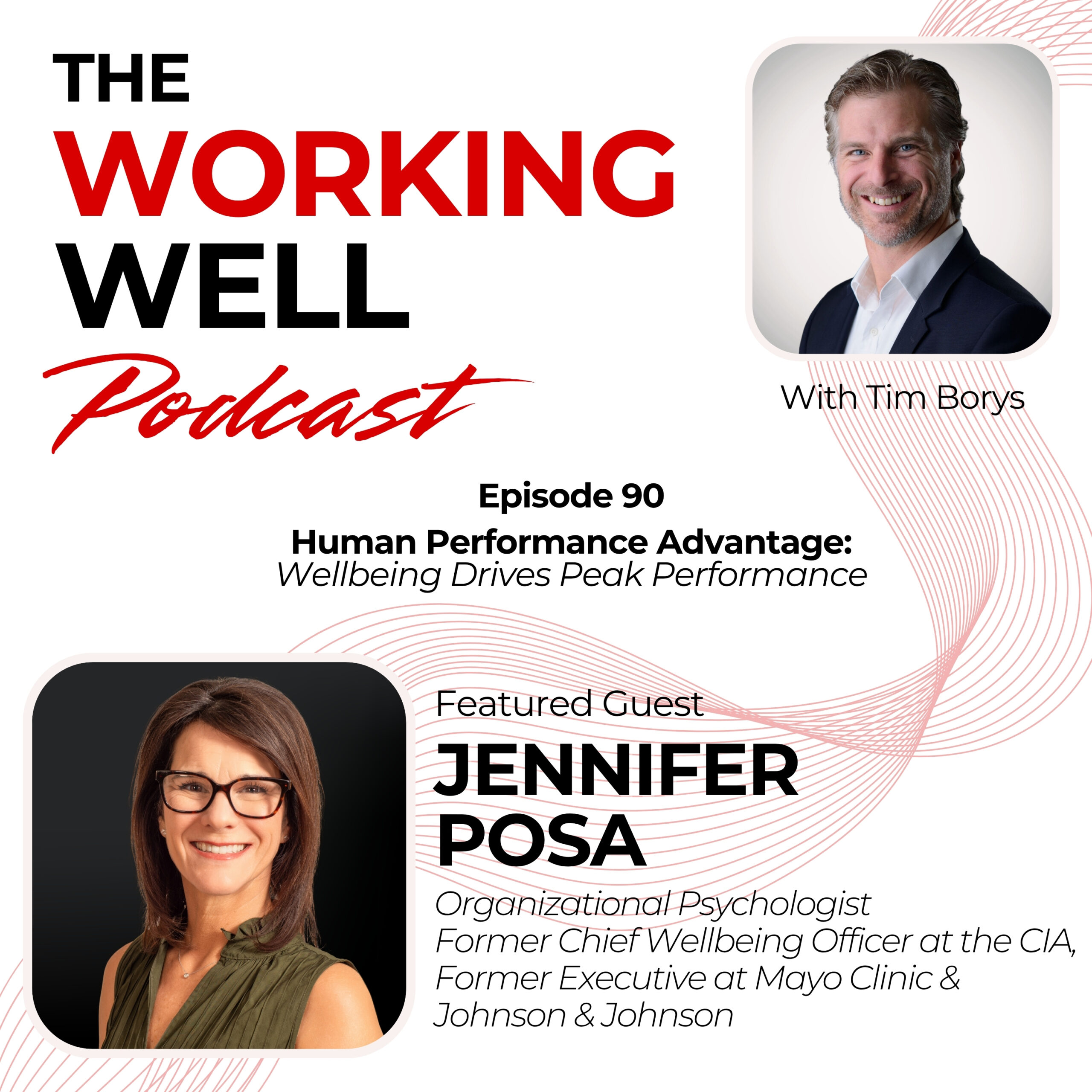
In this episode of the Working Well Podcast, host Tim Borys sits down with Jennifer, a global expert in human performance who previously served as the first Chief Wellbeing Officer at the Central Intelligence Agency.
With leadership experience spanning organizations such as the Mayo Clinic and Johnson & Johnson, Jennifer has spent more than three decades helping elite teams perform at the highest levels under pressure.
In this conversation, she explains why human performance and wellbeing are no longer “nice-to-have” initiatives but strategic advantages for organizations navigating disruption, AI transformation, and constant uncertainty.
Tim and Jennifer explore how high-performing institutions design systems that support mental resilience, emotional strength, and physical readiness—allowing individuals and teams to perform when the stakes are highest.
From intelligence agencies to global healthcare organizations, Jennifer shares lessons on how leaders can create environments where wellbeing fuels performance rather than competing with it.
This episode offers powerful insights for executives, HR leaders, and professionals seeking to build resilient, high-performing teams in a rapidly changing world.
✅ Key Takeaways
- Wellbeing and performance are inseparable. Sustainable results require systems that support both productivity and resilience.
- Uncertainty demands new skills. Adaptability, emotional strength, and resilience are critical in the age of AI and rapid change.
- Elite organizations design performance environments. High-performing institutions intentionally build cultures that enable people to thrive under pressure.
- Wellness is outdated—performance is the future. Modern organizations must move beyond basic health programs toward holistic human performance strategies.
- Human performance is the new competitive advantage. Organizations that invest in people’s physical, mental, and emotional readiness outperform others.
Episode Links & Resources
Connect with Jennifer Posa here:
Website: https://www.drjenniferposa.com/
LinkedIn: https://www.linkedin.com/in/drjenniferposa
Podcast Highlights
Please note: This highlight is generated by a computer and may contain errors.
Introduction: From Intelligence Agencies to Workplace Wellbeing
In this episode of the Working Well Podcast, Tim Borys welcomes Jennifer, a global expert in human performance who previously served as the first Chief Wellbeing Officer at the Central Intelligence Agency.
With an impressive career that includes leadership roles at the Mayo Clinic and Johnson & Johnson, Jennifer has spent decades helping organizations optimize human performance in environments where stakes are high and uncertainty is constant.
Tim opens the conversation by asking what it was like to work at the CIA an organization often surrounded by mystery.
Jennifer describes the experience as both exciting and deeply meaningful.
“It was the honor of a lifetime to support individuals whose mission is safeguarding their country.”
While much of the agency’s work remains confidential, Jennifer emphasizes that at its core, even the most secretive institutions are still organizations made up of people teams that rely on leadership, trust, and performance.
Why Human Performance Is Becoming a Strategic Advantage
According to Jennifer, organizations are now recognizing that human performance is a true competitive advantage.
The reason is simple: the world of work is becoming increasingly complex.
Artificial intelligence, new work models, global disruption, and rapid technological change are forcing organizations to adapt faster than ever before.
Success in this environment requires more than technical expertise it requires individuals who can perform under uncertainty.
“If people aren’t prepared to operate in uncertain environments, it becomes very difficult for them to perform at their highest level.”
Organizations that integrate human performance science into leadership, training, and work design create environments where individuals can thrive even during disruption.
The Link Between Wellbeing and Performance
Jennifer explains that historically, many organizations misunderstood the concept of wellbeing.
For decades, workplace wellness programs were focused primarily on preventing illness offering health screenings, gym memberships, or basic health benefits.
But modern research shows that wellbeing is far more than the absence of disease.
True wellbeing includes:
- Physical strength
- Mental resilience
- Emotional stability
- Strong interpersonal relationships
When these elements are supported, individuals are able to perform at their peak levels.
“If people aren’t physically strong, mentally strong, or emotionally equipped for their work, performance inevitably suffers.”
This shift represents a major evolution in how organizations approach employee health.
Wellbeing is no longer a benefit it’s a performance strategy.
Designing Workplaces for High Performance
Jennifer emphasizes that high-performing organizations intentionally design environments that enable success.
This includes:
- Training people to operate effectively in uncertainty
- Developing leadership that prioritizes resilience and adaptability
- Creating cultures where individuals feel supported and valued
Elite institutions from intelligence agencies to healthcare systemsrecognize that human performance must be built into organizational systems, not left to chance.
Teams that are physically, mentally, and emotionally prepared consistently outperform those that are not.
The Future of Work: Performance in the Age of AI
As artificial intelligence and digital transformation reshape industries, the human side of performance will become even more important.
Technology will change how we work but people will still determine how well organizations perform.
Leaders must therefore shift their focus toward building resilient workforces capable of adapting to constant change.
Organizations that succeed will be those that recognize a fundamental truth:
Performance and wellbeing are not competing priorities they are mutually reinforcing.
Closing Reflections: People at the Center of Performance
Jennifer concludes with a simple but powerful insight.
Every organization, regardless of industry, is ultimately powered by people.
When leaders invest in the wellbeing, resilience, and readiness of those people, they unlock extraordinary potential.
“If we truly want high-performing organizations, we must start with high-performing humans.”